

Long days are part of field service. A no-cool call at 4:30 on a Friday in July does not wait until Monday. What many technicians are less sure about is how the extra hours should be paid. This guide covers the federal rules that apply to most hourly techs in the United States, and the places where the details usually go wrong.
The basic federal rule
The Fair Labor Standards Act (FLSA) says that covered, non-exempt employees must be paid at least one and one-half times their regular rate for every hour worked over 40 in a workweek. Most hourly service technicians are non-exempt.
Three points in that rule matter more than they first appear to:
- It is weekly, not daily. Federal law does not require overtime for a 12-hour day if the week stays at 40 hours or less.
- A workweek is a fixed block of seven consecutive days. Your employer picks when it starts, and it does not have to match the calendar week. Hours cannot be averaged over two weeks. Working 50 hours one week and 30 the next means 10 overtime hours, not zero.
- Weekends and holidays are not automatically overtime. Federal law does not require extra pay for a Saturday or a holiday unless those hours take you past 40.
State rules can be more generous
When state law gives the employee more, the state rule applies. California is the best-known example. It requires overtime after 8 hours in a workday as well as after 40 in a week, and double time after 12 hours in a day. Other states have their own rules, so check with your state labor department.
A worked example
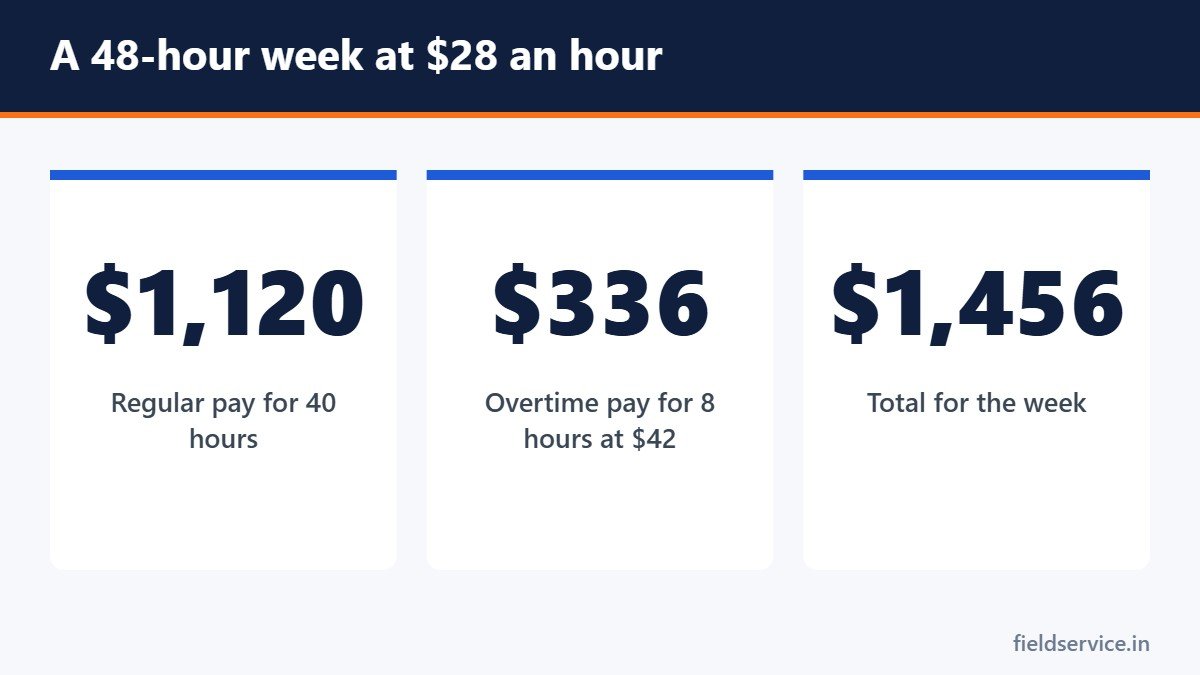
A technician earns $28 an hour and works 48 hours in one workweek.
- Regular pay: 40 × $28 = $1,120
- Overtime rate: $28 × 1.5 = $42
- Overtime pay: 8 × $42 = $336
- Total: $1,456
You can run your own numbers in the overtime pay calculator.
Bonuses and spiffs raise your overtime rate
Overtime is based on your regular rate, and that is not always the same as your hourly wage. Under the FLSA, the regular rate includes most other pay for the week, such as nondiscretionary bonuses, commissions and spiffs. A bonus is nondiscretionary when it is promised in advance, for example $100 for selling a maintenance agreement.
Take the same 48-hour week and add a $100 spiff:
- Straight-time earnings: 48 × $28 + $100 = $1,444
- Regular rate: $1,444 ÷ 48 = $30.08
- Overtime premium: half of $30.08 × 8 hours = $120.33
- Total: $1,444 + $120.33 = $1,564.33
That is $8.33 more than simply adding $100 to the first example. It is a small amount in one week and a noticeable one across a busy season.
Does drive time count?
This is the question technicians ask most. The Department of Labor’s guidance on hours worked draws the line like this:
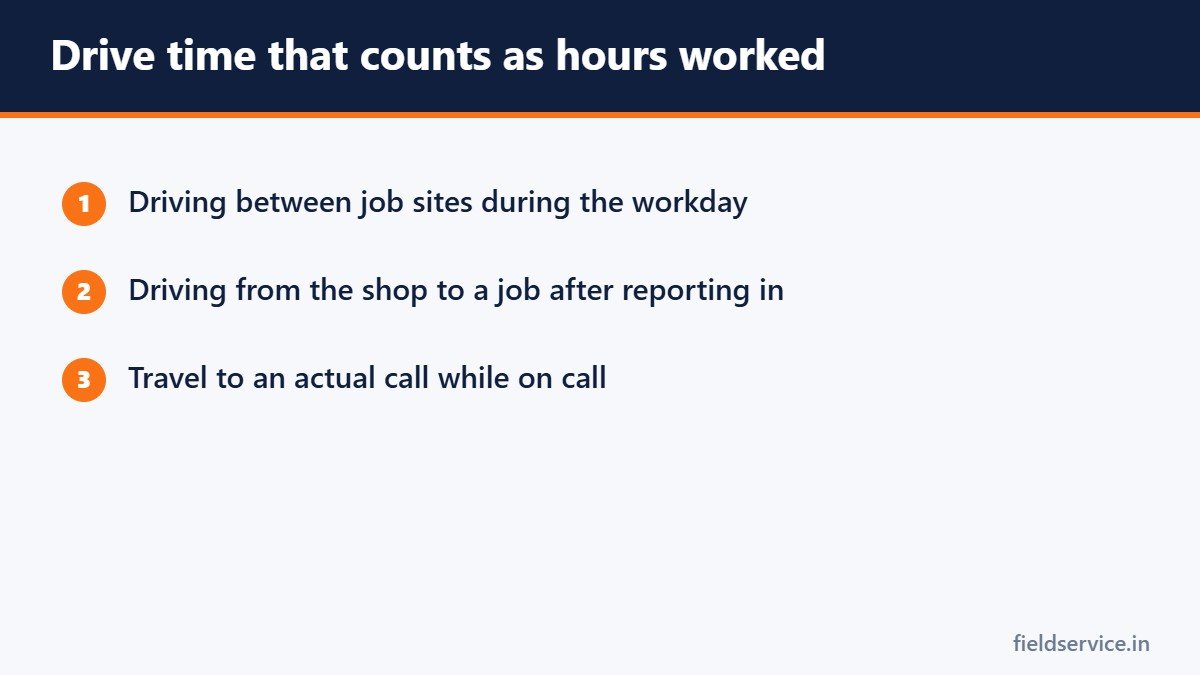
- Ordinary commuting does not count. Driving from home to your first job and from your last job back home is generally not paid time, even in a company vehicle.
- Travel during the workday counts. Driving from one job site to the next is part of the day’s work and must be counted as hours worked.
- Work before you leave can start the clock. If you are required to go to the shop first to pick up parts or get assignments, the drive from the shop to the job is work time.
Dispatch from home sits in a gray area and depends on the facts, so ask your employer how your day is defined and get it in writing.
What about on-call time?
If you must stay at the shop or so close to it that you cannot use the time for yourself, you are working while on call. If you are at home, free to do what you like and only need to answer the phone, the waiting time is generally not hours worked. The time you spend on an actual call always is.
Check your own pay
- Find out which day and time your workweek starts.
- Keep your own record of start and stop times, including drive time between jobs.
- Compare your hours with each pay stub.
- If overtime weeks include a bonus or spiff, check that the overtime rate went up.
- If something looks wrong, raise it with payroll first. The Department of Labor’s Wage and Hour Division and your state labor agency handle complaints.
This article is general information and is not legal advice. Exemptions and state rules vary.
Related guides
- On-Call Pay for Technicians: How It Works and What to Ask
- Per Diem for Field Technicians: How It Works
- IRS Mileage Rate 2026: What Field Technicians Need to Know After the July Increase
Sources
- U.S. Department of Labor, Fact Sheet #23: Overtime Pay Requirements of the FLSA
- U.S. Department of Labor, Fact Sheet #22: Hours Worked Under the FLSA
- California Department of Industrial Relations, Overtime FAQ
Six everyday forms in Word and PDF, plus Excel workbooks that total mileage reimbursement and overtime pay.
Not sure yet? Try two forms free or see all packs.