


A ladder slides a foot sideways and the technician grabs the gutter. A van reverses within inches of a child’s bicycle. A breaker labeled “furnace” turns out to feed something else. Nobody is hurt, the job gets done, and nobody mentions it. That silence is expensive. Near miss reporting gives a service business the chance to fix a hazard before it injures someone, and it costs almost nothing. This guide covers what to report, how to look into it, and what federal rules require when someone is hurt.
Incident, near miss and hazard: the terms
| Term | Meaning | Example |
|---|---|---|
| Hazard | A condition that could cause harm | A cracked ladder rail |
| Near miss | An unplanned event that could have caused injury or damage but did not | The ladder slips; the technician is not hurt |
| Incident | An unplanned event that causes injury, illness or damage | The technician falls and sprains a wrist |
| Recordable injury | An incident that meets OSHA’s criteria for the injury log | The sprain needs medical treatment beyond first aid |
The difference between a near miss and an injury is often a matter of inches or luck. The cause is the same, which is why near misses are worth as much attention as injuries.
Why near misses go unreported
- Fear of blame, discipline or looking careless.
- Reporting takes too long or the form is hard to find.
- Nothing happened the last time someone reported.
- Bonuses or safety awards that depend on having no reports.
- “Nobody got hurt, so it does not matter.”
Every one of these is a management problem, not a technician problem. If reports lead to blame, the reports stop and the hazards stay.
How to build a reporting habit
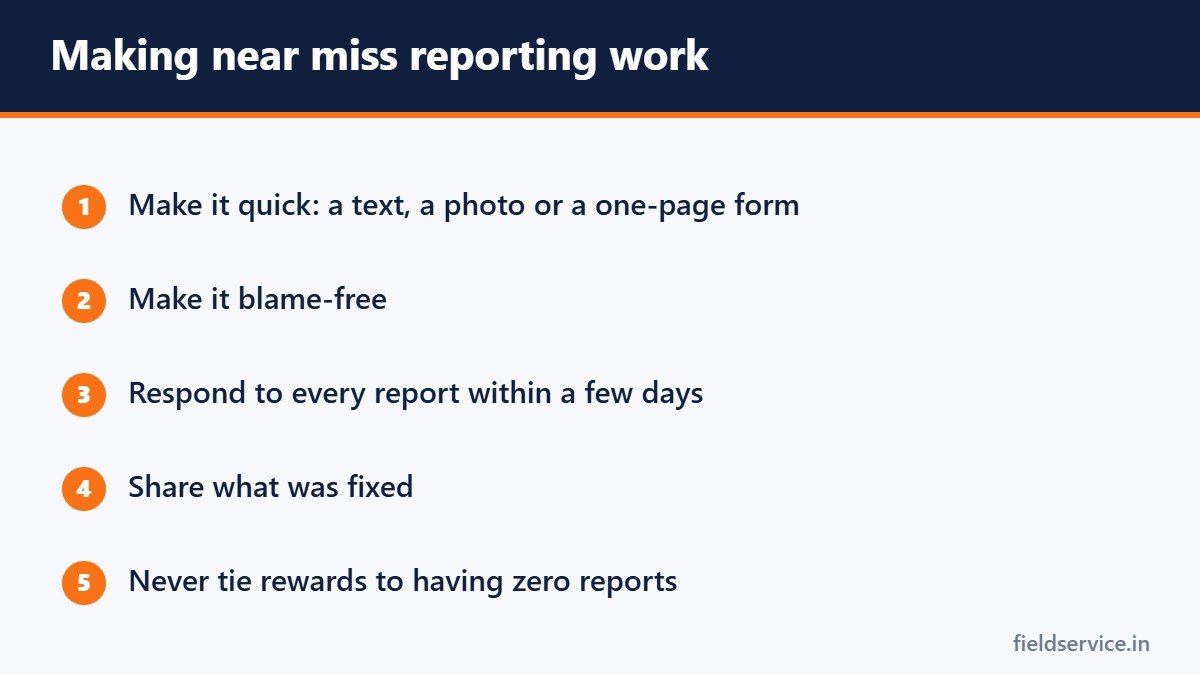
- Keep it simple. A technician in a driveway will send a photo and two sentences. They will not fill in four pages.
- Thank the reporter. Treat a report as help, not as a confession.
- Close the loop. Tell the crew what was reported and what changed because of it. Weekly safety meetings are the natural place; see toolbox talks for service technicians.
- Count reports as a good sign. A rising number of near miss reports usually means trust is improving, not that work is becoming more dangerous.
What a report should capture
- Date, time and location.
- Who was involved and who saw it.
- What happened, in the order it happened.
- What the person was doing at the time, and with what tools.
- Conditions: weather, lighting, access, time pressure.
- What was done immediately to make things safe.
- Photos of the scene before anything is moved, where that is safe.
Investigating: look for causes, not culprits
“Technician was careless” is not a finding. It does not tell you what to change. A useful investigation keeps asking why until it reaches something the company can fix.
- Why did the ladder slip? It was set on wet decking.
- Why was it set there? It was the only spot that reached the unit.
- Why was that the only spot? The truck carried one ladder, and it was too short for a better position.
- Why only one ladder? The truck stock list has not been reviewed since the company began servicing rooftop units.
The fix is a change to the stock list and a rule about ladder footing, not a warning letter. Corrective actions should have an owner and a due date, and someone should check they were completed. A job hazard analysis for the task is often the right place to record the new control.
When an injury happens: OSHA reporting deadlines
Federal OSHA requires every covered employer, whatever its size, to report the most serious events directly to OSHA:

Reports can be made by phone to the nearest OSHA area office, to the OSHA 24-hour hotline, or online. States that run their own OSHA-approved plans may have additional or stricter requirements.
OSHA injury and illness records
Separately from reporting, many employers must keep injury and illness records on OSHA Forms 300, 300A and 301.
- Who is exempt: employers with ten or fewer employees at all times during the previous calendar year, and establishments in certain low-hazard industries, are partially exempt from keeping these records. They must still report the severe events above.
- What is recordable: in general, a work-related injury or illness that results in death, days away from work, restricted work or job transfer, medical treatment beyond first aid, or loss of consciousness, or that is a significant injury or illness diagnosed by a licensed health care professional.
- Timing: a recordable case must be entered within seven calendar days of learning about it.
- Annual summary: Form 300A must be posted in the workplace from February 1 to April 30 each year.
- Retention: the records must be kept for five years.
Near misses are not recordable on the OSHA log. Keep them in your own log.
Do not forget workers’ compensation
A work injury usually also triggers a claim under your state’s workers’ compensation system. States and insurers set their own deadlines for reporting a claim, and they can be short. Know your insurer’s process before you need it.
Keep a simple log
A spreadsheet is enough. Record each near miss and incident with its date, type, location, cause, corrective action, owner and the date the action was closed. Review it every quarter for patterns: the same task, the same site type, the same time of day. Patterns show where to spend your safety effort. Track open actions alongside your other field service KPIs.
Related guides
- Ladder safety for service technicians
- Driving safety for service technicians
- Lone worker safety for field technicians
Sources
- OSHA: Report a fatality or severe injury
- OSHA: Injury and illness recordkeeping and reporting requirements
Seven safety forms in Word and PDF, plus an Excel log that counts incidents, open actions and safety meetings.
Not sure yet? Try two forms free or see all packs.
Frequently asked questions
What is a near miss?
A near miss is an unplanned event that did not cause injury, illness or damage but could have. A ladder that slips without anyone falling is an example.
Does OSHA require near miss reporting?
No. OSHA does not require employers to report or record near misses. It encourages employers to investigate them because they reveal hazards before someone is hurt.
How quickly must a serious injury be reported to OSHA?
A work-related fatality must be reported within 8 hours. An inpatient hospitalization, amputation or loss of an eye must be reported within 24 hours.
Do small businesses have to keep an OSHA 300 log?
Employers with ten or fewer employees throughout the previous calendar year are partially exempt from routine injury and illness recordkeeping, as are certain low-hazard industries. They must still report fatalities and severe injuries.
Should technicians be disciplined after a near miss?
Discipline for reporting discourages future reports. Most safety professionals recommend treating near miss reports as blame-free and focusing on fixing the cause.
This article is general information about federal requirements and is not legal advice. State-plan states and workers’ compensation rules differ. Check the requirements that apply to your business.