

Ask technicians what the most dangerous part of the job is and they will mention electricity, ladders or gas. The statistics point somewhere else. Transportation incidents are the leading cause of work-related deaths in the United States, according to the Bureau of Labor Statistics. A service technician spends hours each day in a loaded van or truck, often in a hurry, in unfamiliar streets, while a phone delivers the next job. Most crashes come from a handful of habits that can be changed.
A service vehicle is not a car
- It is heavier, so it takes longer to stop.
- It has larger blind spots, especially a van with no rear windows.
- It sits higher, and a ladder rack raises the center of gravity and the overall height.
- Unsecured tools and parts become projectiles in a hard stop.
Phones and dispatch
Distraction is the hazard most specific to service work. The job arrives by phone, the customer calls by phone and the route is on the phone.
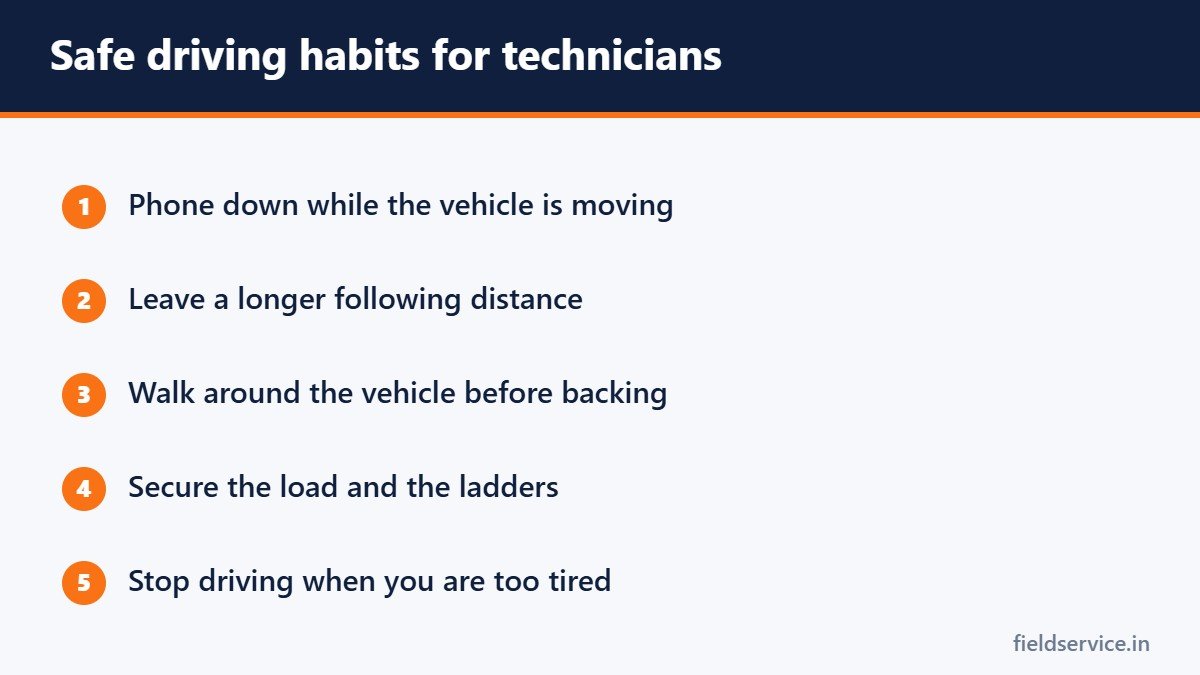
- Set the navigation before you move.
- Do not read or type messages while driving. Pull over.
- Let calls go to voicemail, or use hands-free only where the law and company policy allow, and keep calls short.
- Do paperwork and job notes while parked.
Many states prohibit handheld phone use while driving, and most prohibit texting. Dispatchers can help by not calling technicians who are known to be on the road.
Following distance and speed
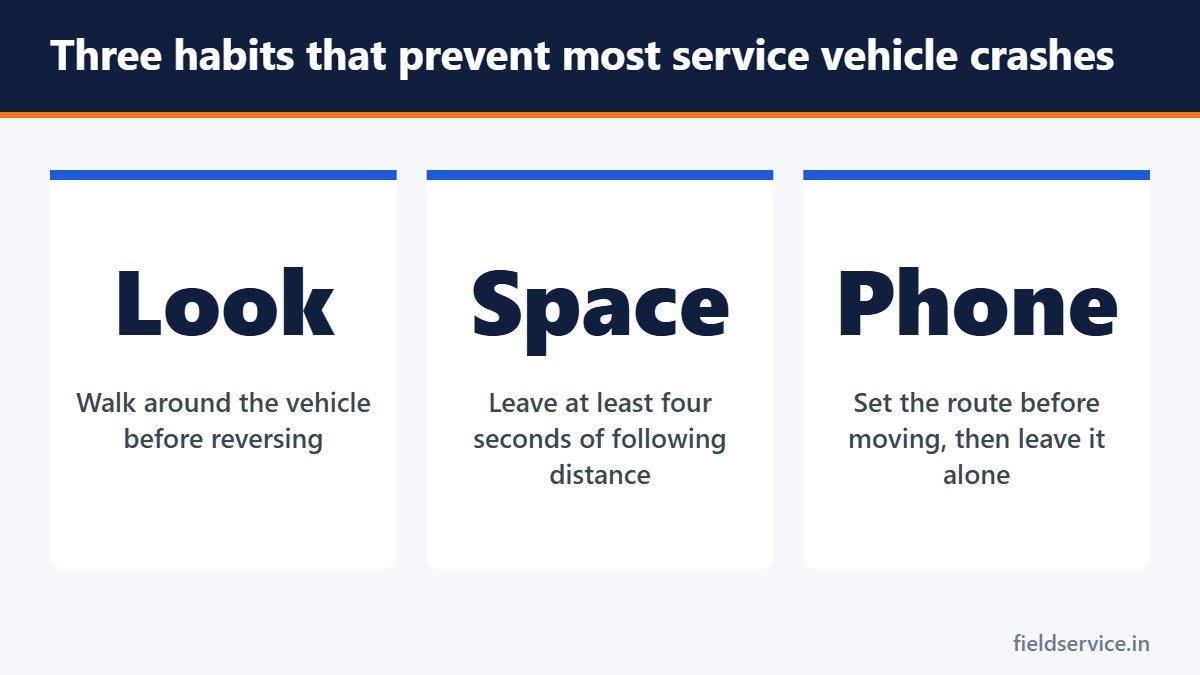
A loaded service vehicle needs much more room to stop than a car. Leave at least four seconds between you and the vehicle ahead, and more in rain, snow or heavy traffic. Running late is the usual reason for speeding and tailgating. A call to say you will be ten minutes late is a far better outcome than a collision. Our article on on-time arrival covers the scheduling side.
Backing
A large share of service vehicle collisions happen in reverse, at low speed, in driveways and parking lots. They are almost entirely avoidable.
- Avoid backing where you can. Park so that your first move is forward. Pull through, or back in on arrival while you can still see what is around.
- Get out and look. Walk around the vehicle before reversing. Check for children, pets, toys, posts and low walls.
- Use a spotter if one is available.
- Back slowly, using mirrors and the camera together. A camera does not show everything.
- Be especially careful in residential driveways, where small children may be nearby.
Securing the load
- Fit a bulkhead or partition between the cargo area and the cab.
- Keep heavy items low and against the partition.
- Use shelving and bins with restraints, not loose stacks.
- Secure gas cylinders upright, with caps on, in a ventilated area, as the rules for the gas require.
- Strap ladders at more than one point and check the rack fastenings.
- Know the height of your vehicle with the ladders on, and watch for low clearances.
- Do not exceed the gross vehicle weight rating on the door jamb label.
Fatigue
Long days in peak season and overnight call-outs make drowsy driving a real risk. Tiredness slows reactions in a way similar to alcohol. If you find yourself drifting, missing turns or struggling to keep your eyes open, stop. Tell dispatch. A short rest is not a failure. See emergency and after-hours service calls.
Weather
- Slow down and increase following distance in rain, snow and fog.
- Clear all windows, mirrors and lights of snow and ice before moving.
- Be cautious on bridges and shaded roads, which freeze first.
- If conditions are unsafe, say so. A rescheduled call is better than a crash.
Before you drive
A two-minute walk-around catches flat tires, lights that are out and loose ladders. Our daily vehicle inspection checklist on the templates page lists what to check. Wear your seat belt on every trip, however short.
Parking at the job
- Park legally, and where you will not block the customer or the neighbors.
- Avoid parking where you will have to reverse into traffic.
- On a slope, turn the wheels to the curb and set the parking brake.
- Use cones or hazard lights if you must stop at the roadside.
- Lock the vehicle. Tool theft from service trucks is common.
If you are in a collision
- Check for injuries and call 911 if anyone is hurt.
- Move to a safe place if the vehicles can be moved.
- Call the police where required, and your supervisor.
- Exchange names, insurance and vehicle details.
- Take photos of the scene, the vehicles and the surroundings.
- Do not discuss fault at the scene.
- Write down what happened while it is fresh.
For owners
- Check driving records when hiring and at intervals afterward.
- Write a clear policy on phone use and enforce it.
- Schedule realistically, so that nobody has to speed to meet a window.
- Maintain the vehicles and act on reported defects.
- Fit partitions, shelving and backup cameras.
- Review any incident for its cause, not only for blame.
- Consider vehicle tracking with driver feedback. See GPS fleet tracking for service businesses.
Less time on the road also means less exposure. See how to reduce windshield time.
Seven safety forms in Word and PDF, plus an Excel log that counts incidents, open actions and safety meetings.
Not sure yet? Try two forms free or see all packs.
Frequently asked questions
What is the most common type of service vehicle accident?
Low-speed collisions while backing, in driveways and parking lots, are among the most common. Walking around the vehicle before reversing and parking so you can pull forward prevent most of them.
How much following distance should a service van leave?
At least four seconds in good conditions, and more in rain, snow or heavy traffic. A loaded vehicle needs more distance to stop than a car.
Can technicians use a phone for navigation while driving?
Set the route before moving and use a mount. Handheld use while driving is prohibited in many states, and company policy may be stricter than the law.
What should I do after a collision in a company vehicle?
Check for injuries, call 911 if needed, move to safety, notify the police where required and your supervisor, exchange details, take photos and avoid discussing fault at the scene.
This article is a general overview. Follow traffic laws and your employer’s vehicle policy.
Related guides
- Heat Safety for Field Technicians: Working Through Hot Weather
- Ladder Safety for Service Technicians
- Cold Stress: Staying Safe on Winter Service Calls