

Every winter brings calls from heat pump owners who see their outdoor unit steaming, hear a loud whoosh, or find it encased in ice. Some of these calls are normal operation that nobody explained to the customer. Others are a real fault that will leave the home without efficient heat. Knowing how defrost is supposed to work is the key to telling the two apart quickly.
Why heat pumps need to defrost
In heating mode, the outdoor coil is the evaporator. It absorbs heat from outdoor air and runs colder than the air around it. When the coil surface is below freezing and the air is humid, moisture freezes onto the fins. A thin layer is normal. A thick layer blocks airflow, cuts heating capacity and can damage the unit if it keeps building.
What happens during a defrost cycle
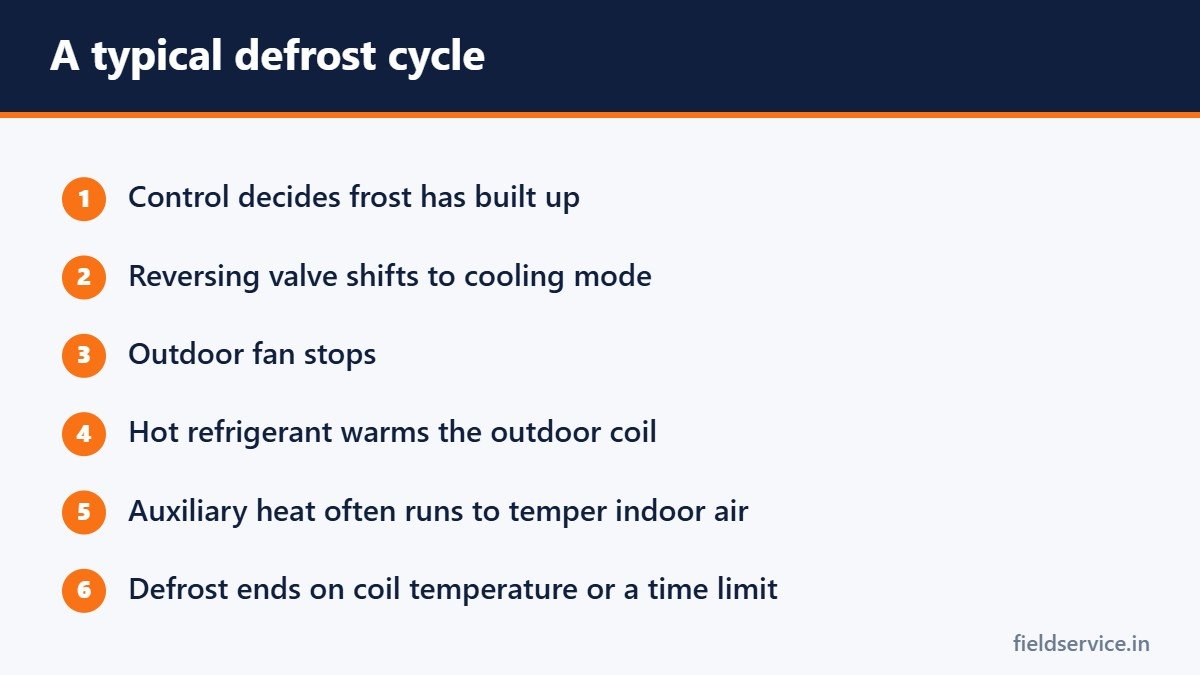
During defrost the outdoor unit may hiss or whoosh as the reversing valve shifts, and steam often rises from the coil as the frost melts. Customers sometimes think the unit is on fire. It is worth explaining this on every heat pump installation and maintenance visit.
How the control decides when to defrost
| Defrost type | How it works |
|---|---|
| Time and temperature | When the coil sensor reads cold, the board starts defrost at fixed run-time intervals, often selectable on the board |
| Demand defrost | The board compares coil and outdoor air temperatures, or other inputs, and defrosts only when frost is likely |
| Termination | Defrost ends when the coil sensor reaches the termination temperature, or after a maximum time |
Set points, intervals and maximum times vary by manufacturer and model. Check the installation manual or the label inside the control panel.
Normal or a problem?
- Normal: light frost that clears regularly; steam during defrost; a short period of cooler air indoors if auxiliary heat is not used.
- Problem: a coil that stays solid with ice, ice building on the top of the unit or around the base, or a unit that seems to be in defrost too often.
Diagnosing a heat pump that will not defrost
- Check what is outside the unit. Water dripping from a gutter or roof edge can freeze onto the unit regardless of defrost. Snow drifts and a unit sitting on the ground with no drainage cause similar problems.
- Check the coil sensor. Make sure it is clipped firmly to the correct tube and insulated if specified. Measure its resistance against the manufacturer’s temperature chart.
- Force a defrost. Many boards have test pins or a button to start defrost. Confirm the reversing valve shifts, the outdoor fan stops and the coil starts to clear.
- Check the reversing valve. If the board calls for defrost but the valve does not shift, check for voltage at the solenoid coil, then the coil itself, then a sticking valve.
- Check the outdoor fan relay. If the fan keeps running in defrost, the coil may never warm enough to clear.
- Check the refrigerant charge. A low charge makes the outdoor coil run colder and frost faster. Follow the manufacturer’s heating-mode charging method. See refrigerant leak detection methods.
- Check indoor airflow. Low indoor airflow in heating mode raises head pressure and affects the whole cycle. See static pressure.
Safe ways to clear a frozen unit
If a unit is heavily iced, you may need to clear it before diagnosing. Turn the unit off and let it thaw, or use the system’s own defrost if it works. Warm water can be used carefully. Never chip at ice with tools, because coil fins and tubes are easily damaged and a punctured coil means a refrigerant leak.
Prevent repeat calls
- Raise the outdoor unit on a stand or pad so meltwater drains away, especially in snowy areas.
- Keep it clear of roof drips and downspouts.
- Clean the outdoor coil at maintenance visits.
- Explain normal defrost to the customer so they do not call for steam.
For the basics of how heat pumps work, see heat pump basics. Our wiring diagram guide helps when tracing the reversing valve and defrost circuits.
Related guides
Sources
Six everyday forms in Word and PDF, plus Excel workbooks that total mileage reimbursement and overtime pay.
Not sure yet? Try two forms free or see all packs.
Frequently asked questions
Is it normal for a heat pump to steam in winter?
Yes. During a defrost cycle the outdoor coil is warmed to melt frost, and the melting frost often produces visible steam. It usually lasts a few minutes.
How often should a heat pump go into defrost?
It depends on the control type, outdoor temperature and humidity. Time-and-temperature controls defrost at set intervals when the coil is cold; demand defrost controls defrost only when frost is likely.
Why is my heat pump covered in ice?
Common causes include a failed coil sensor or defrost control, a reversing valve that does not shift, an outdoor fan that keeps running in defrost, a low refrigerant charge, or water dripping onto the unit from above.
Can I pour hot water on a frozen heat pump?
Warm water can be used carefully to help clear ice. Never chip at ice with tools, because the coil is easily damaged.
This article is general information for trained technicians. Defrost controls differ by manufacturer; follow the installation and service instructions for the equipment.