

Few conversations matter more to a homeowner than “should we fix it or replace it?” The answer can be worth thousands of dollars, and the customer usually has to decide quickly, in a cold or hot house, from someone they have just met. A technician who explains the choice clearly and honestly earns trust that lasts for years. One who pushes replacement when a repair would do loses it. This guide covers the factors that matter and a simple way to put them in front of the customer.
The factors that matter
Age and expected life
Equipment life depends on the type of system, the climate, the quality of the installation and how well it was maintained. Many furnaces and air conditioners last somewhere around 15 years, but some fail much sooner and others run for decades. Use the manufacturer’s guidance and your own experience in your area rather than one number for everything. The serial number on the data plate usually tells you the manufacture date.
The $5,000 rule
A common rule of thumb in the trade is to multiply the age of the equipment in years by the cost of the repair. If the result is more than about 5,000, replacement deserves a serious look. A $400 repair on a 6-year-old system scores 2,400, which points to repair. An $1,800 repair on a 12-year-old system scores 21,600, which points toward at least pricing a replacement.
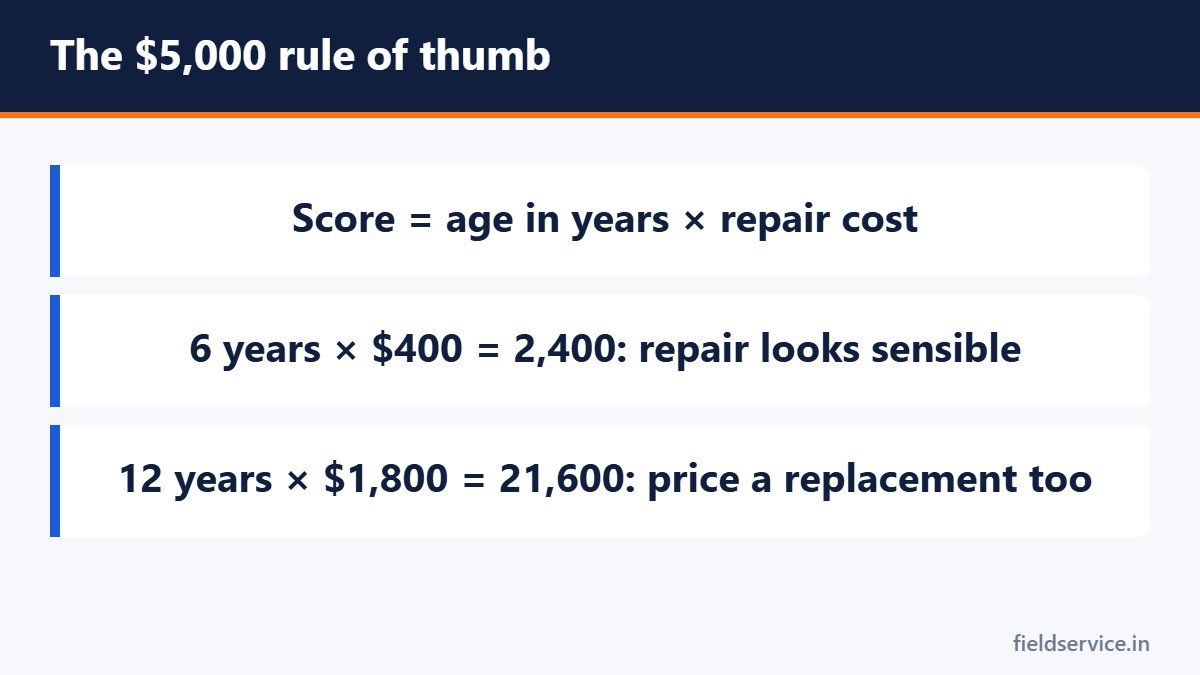
It is a starting point, not a verdict. It ignores efficiency, refrigerant and comfort, and the threshold has stayed the same while prices have risen.
Cost per year of remaining life
A clearer way to compare is to spread each option over the years it buys. If a 12-year-old system with an expected 15-year life needs an $1,800 repair, that repair buys perhaps three more years: about $600 a year. A $9,000 replacement lasting 15 years costs about $600 a year too, before any energy savings. If a new system cut a $1,600 annual energy bill by 20 percent, its yearly cost would fall to about $280.
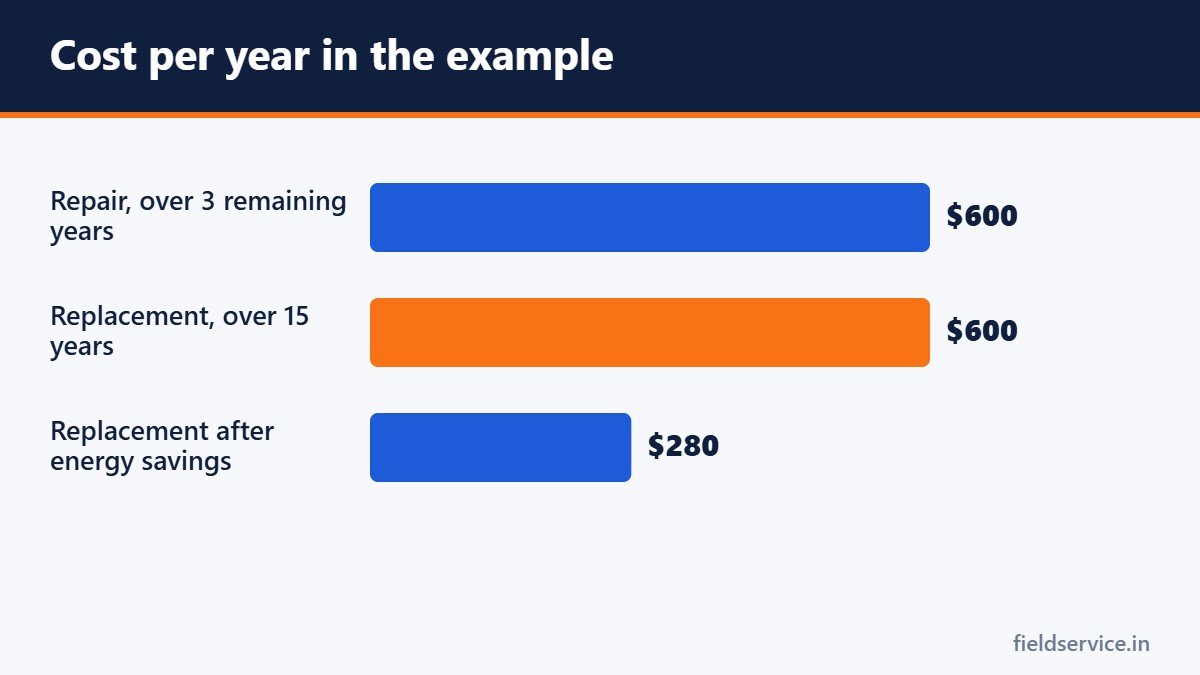
Energy savings depend on how efficient the old and new equipment are and how the home is used. Be cautious, and never promise a saving you cannot support. You can run the comparison in the HVAC repair or replace calculator.
Refrigerant and parts availability
Older systems may use refrigerants that are being phased down or are no longer produced, which can make major refrigerant repairs expensive. Parts for discontinued models can also be hard to find. These are legitimate reasons to discuss replacement; see the R-410A rule changes for the current picture on one common refrigerant.
Safety comes first
If you find a condition that makes the equipment unsafe, such as a cracked heat exchanger or a venting problem, the decision is no longer only about money. Explain the hazard clearly, follow your company’s procedure and local rules for unsafe appliances, and document what you found and what you told the customer. See carbon monoxide safety.
How to present the choice
- Explain what failed and why, in plain language. Show the part or a photo.
- Give the repair price and what it is likely to buy in years of service.
- Mention anything else you saw that is likely to fail soon.
- Give a replacement price, or offer a proper replacement estimate.
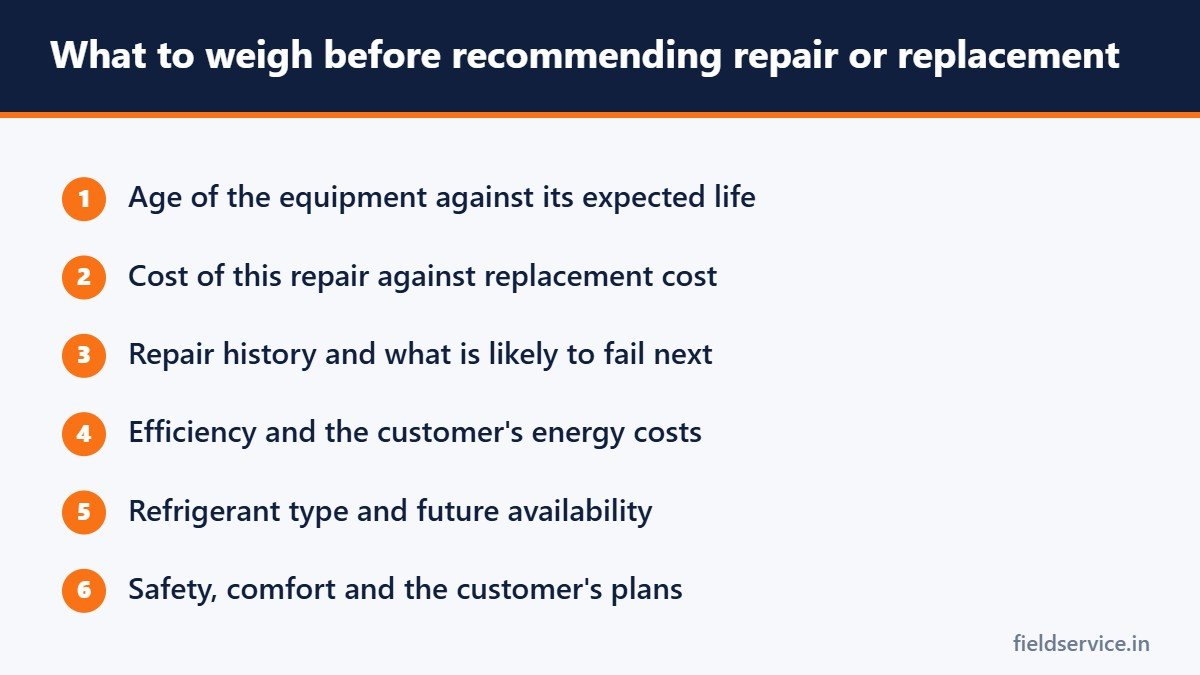
- Lay out the factors: age, cost per year, efficiency, refrigerant, comfort.
- Ask about their plans: are they selling the house soon, or staying for years?
- Respect the decision and record it on the ticket.
Offering both options with clear prices is the same approach as good, better, best options. Our guide on explaining a repair to a customer has more on the conversation itself.
When repair is the right answer
- The equipment is relatively young and the repair is modest.
- The system has been reliable and well maintained.
- The customer plans to move soon or needs time to save for a replacement.
- Parts and refrigerant are readily available.
Related guides
Sources
- ENERGY STAR: Heating and cooling maintenance checklist
- U.S. Environmental Protection Agency: Section 608 refrigerant management
Six everyday forms in Word and PDF, plus Excel workbooks that total mileage reimbursement and overtime pay.
Not sure yet? Try two forms free or see all packs.
Frequently asked questions
What is the $5,000 rule for HVAC?
A rule of thumb: multiply the age of the equipment in years by the repair cost. If the result is above about 5,000, replacement is often worth considering. It is a guide, not a firm rule.
How long should an HVAC system last?
It depends on the equipment, climate, installation and maintenance. Many furnaces and air conditioners last around 15 years, but individual systems vary widely.
Is it worth repairing a 15-year-old air conditioner?
Sometimes. A small, inexpensive repair on a reliable system can make sense. A major repair, especially involving the compressor or refrigerant, often makes replacement worth pricing.
Should technicians recommend replacement?
They should explain the options honestly, with prices and the facts behind them, and let the customer decide. Recommending replacement when a sound repair is available damages trust.
This article is general information. Equipment life, efficiency and costs vary. It does not replace a technician’s on-site assessment or manufacturer guidance.