

An air conditioner removes moisture from the air as well as heat. On a humid day a residential system can produce several gallons of water, all of which has to leave the building through a small plastic pipe. When that pipe blocks, the water goes somewhere else: through a ceiling, into a furnace or across a floor. Condensate problems are among the most common summer service calls, and many of them are preventable at the maintenance visit.
How the drain system works
Water vapor in the return air condenses on the cold evaporator coil and drips into the primary drain pan under the coil. From there it flows through the primary drain line to a suitable discharge point.
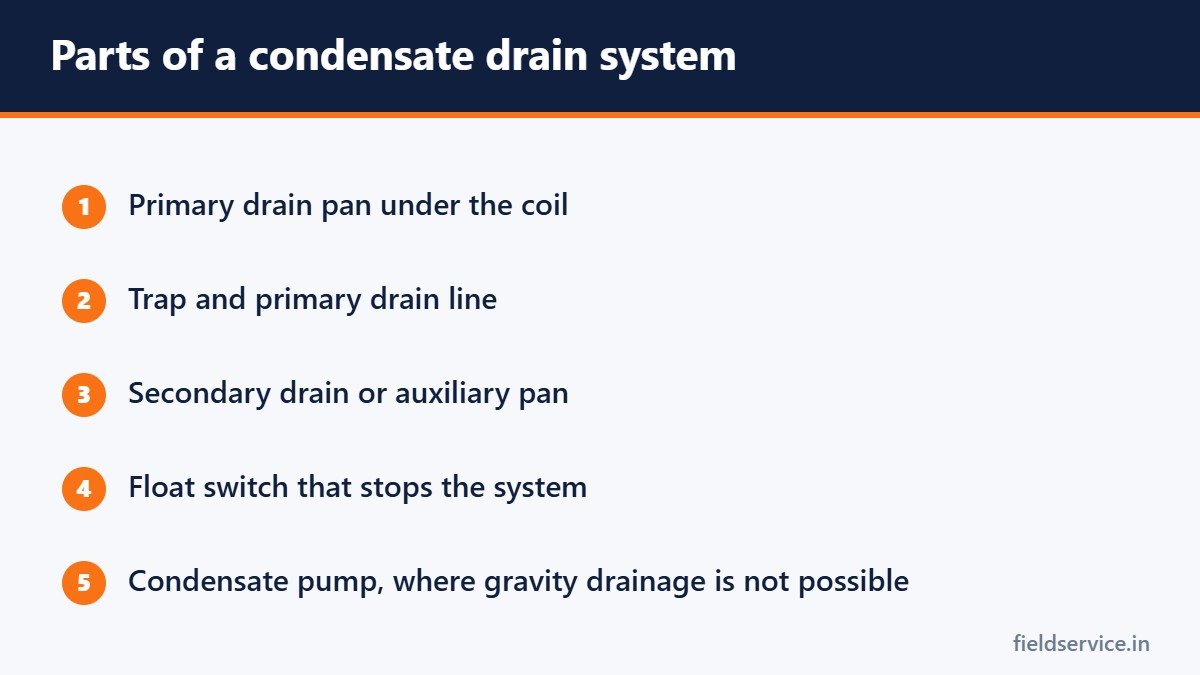
- Primary drain pan and line. The normal path for condensate.
- Trap. A U-shaped section in the drain line. On a coil where the blower pulls air through, the pan is under negative pressure, and without a trap, air is drawn up the drain and holds the water back.
- Secondary drain or auxiliary pan. Where a leak could damage the building, such as an attic installation, codes generally require a backup: a second drain line, an auxiliary pan under the unit with its own drain, or a device that shuts the system off.
- Float switch. A safety switch in the pan or the line that stops the system when water rises.
- Condensate pump. Used where the water cannot drain by gravity, as in a basement.
Why drains clog
- Biological growth. The pan is dark and wet, and algae and slime grow in it and in the trap.
- Dust and debris washed off a dirty coil. A poor filter makes this worse.
- Rust and scale from an old metal pan.
- Insufficient slope. A line that sags or runs uphill holds water and sludge. Mechanical codes generally require a minimum slope of one-eighth inch per foot.
- A missing or wrongly built trap.
- Insects or debris blocking the outlet.
Symptoms
- Water in the auxiliary pan, or dripping from the secondary drain
- Stains on a ceiling under an attic unit
- Water around the indoor unit
- The system will not run because the float switch has tripped
- A musty smell from the vents
If the secondary drain is discharging, or the auxiliary pan has water in it, the primary drain is blocked. Secondary outlets are often placed over a window or door precisely so that the dripping is noticed.
How to clear a blockage
- Turn the system off.
- Remove standing water from the pan with a wet vacuum.
- Find the cleanout or access point near the unit.
- Apply a wet vacuum to the outlet end of the drain line and draw the blockage out. This is usually the most effective method.
- Alternatively, clear the line with a drain brush or a controlled burst from a drain gun or nitrogen. Use low pressure and protect the pan and fittings. Too much pressure can blow joints apart inside a wall or ceiling.
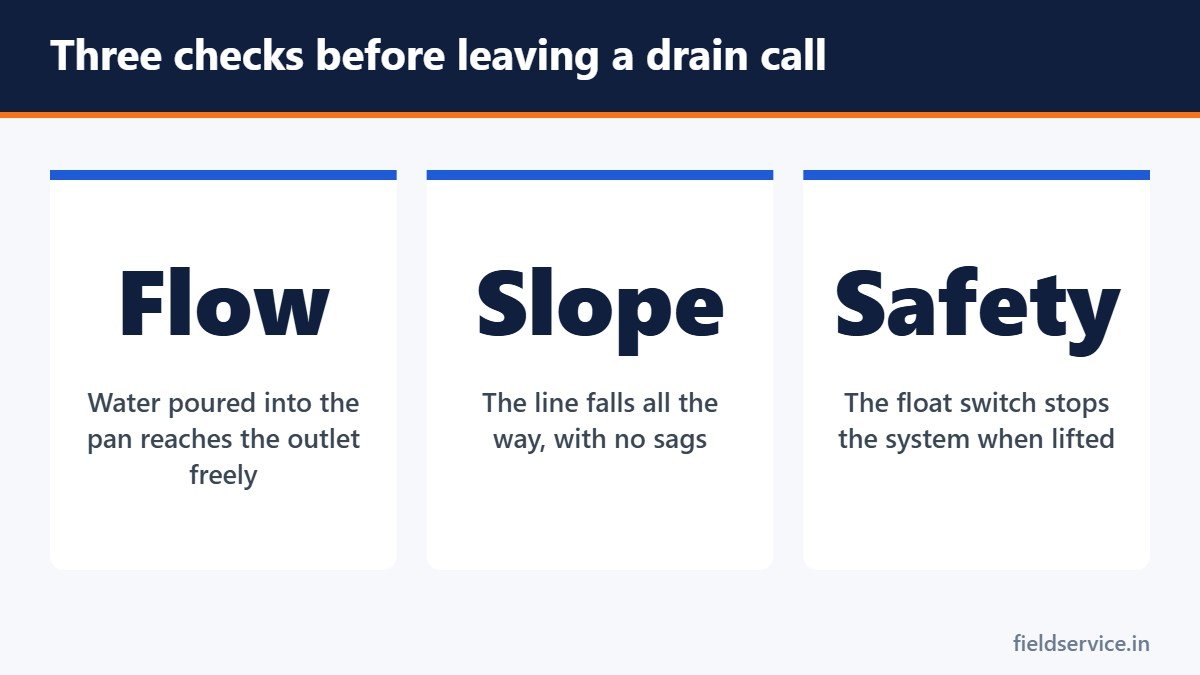
- Flush the line with water and confirm that it flows freely to the outlet.
- Clean the pan and the trap.
- Test the float switch by lifting it and confirming that the system stops.
Find the reason
A cleared drain that clogs again in a month is a callback. Before you leave, look for the cause:
- Is the coil dirty? A dirty coil feeds debris into the pan.
- Is the filter the right type, and is it being changed?
- Does the line slope continuously to the outlet, with no sags?
- Is there a trap, and is it the right depth for the unit?
- Is the pan cracked or rusted through?
- Is the line long, with many bends?
Condensate pumps
A pump has a small reservoir, a float and usually a safety switch. Common faults are a stuck float, a blocked check valve, a kinked or blocked discharge tube and a failed motor. Clean the reservoir at each maintenance visit, because slime builds up in it. Test the pump by pouring water into the reservoir and watching it discharge. If the pump has a safety switch, check that it is wired to stop the system. Many are installed with those wires left unconnected.
High-efficiency furnaces
Condensing furnaces also produce condensate, in the heating season. This water is acidic. Many jurisdictions and manufacturers require it to pass through a neutralizer before it reaches the drain, particularly with metal drain piping or a septic system. The furnace’s internal trap and drain hoses also need cleaning. A blocked furnace condensate drain typically shuts the furnace down on a pressure switch fault.
Prevention at the maintenance visit
- Flush the drain line with water.
- Clean the pan and the trap.
- Clean the coil if it needs it.
- Test the float switch.
- Check the slope and the supports on the line.
- Check the auxiliary pan for rust and debris.
- Use pan tablets or treatments only where the equipment manufacturer approves them. Some chemicals damage coils and pans.
Our HVAC preventive maintenance checklist on the templates page includes the drain.
What to tell the customer
- Change the filter on schedule.
- Know where the secondary drain outlet is, and call if it starts to drip.
- If the system stops and the thermostat is blank or shows no cooling, a tripped float switch is a likely cause.
- Do not pour bleach or other chemicals into the drain without checking what the manufacturer allows.
Installation points that prevent problems
- Provide a cleanout near the unit.
- Build the trap to the manufacturer’s dimensions.
- Support the line so that it cannot sag.
- Insulate the line where it runs through a hot attic, to stop it sweating.
- Fit a float switch on every attic installation, whatever else is provided.
- Follow the equipment instructions and the code adopted locally.
Related guides
- Voltage Drop Explained: Causes, Calculation and Limits
- Furnace Tune-Up Checklist: What a Technician Should Check
- Thermostat Wiring Explained: What Each Terminal Does
Six everyday forms in Word and PDF, plus Excel workbooks that total mileage reimbursement and overtime pay.
Not sure yet? Try two forms free or see all packs.
Frequently asked questions
Why is water dripping from the pipe above my window?
That is likely the secondary drain outlet. It discharges when the primary drain line is blocked, and it is often placed where the dripping will be noticed. The primary drain needs clearing.
Why did my air conditioner stop running with water in the pan?
A float switch has probably tripped. It shuts the system off when water rises in the pan or drain line to prevent an overflow.
How often should a condensate drain be cleaned?
It should be flushed and checked at each maintenance visit, usually once or twice a year. Systems in humid climates or with a history of clogs may need it more often.
Does a condensate drain need a trap?
On a coil where the blower draws air through, the drain pan is under negative pressure and a trap is needed for the water to drain properly. Follow the equipment manufacturer’s instructions for the trap dimensions.
This article is an educational overview. Follow the equipment manufacturer’s instructions and the mechanical code adopted in your area.