

Heat pumps are being installed in growing numbers across the United States, including in climates where they were once rare. Technicians who learned on air conditioners and gas furnaces sometimes find them puzzling: an outdoor unit that runs in winter, steams on a cold morning and blows air that feels only lukewarm. All of that is normal. A heat pump is an air conditioner that can run in both directions, and once that is clear, the rest follows.
The basic idea
A furnace makes heat by burning fuel or passing current through a resistance element. A heat pump moves heat that already exists. Even cold outdoor air contains heat energy. The refrigerant absorbs that heat outdoors and releases it indoors. Because it is moving heat and not creating it, a heat pump can deliver more heat energy than the electrical energy it consumes.
Cooling mode
In cooling, a heat pump works exactly like an air conditioner. The indoor coil is the evaporator, where refrigerant absorbs heat from the house. The outdoor coil is the condenser, where that heat is rejected outside.
Heating mode
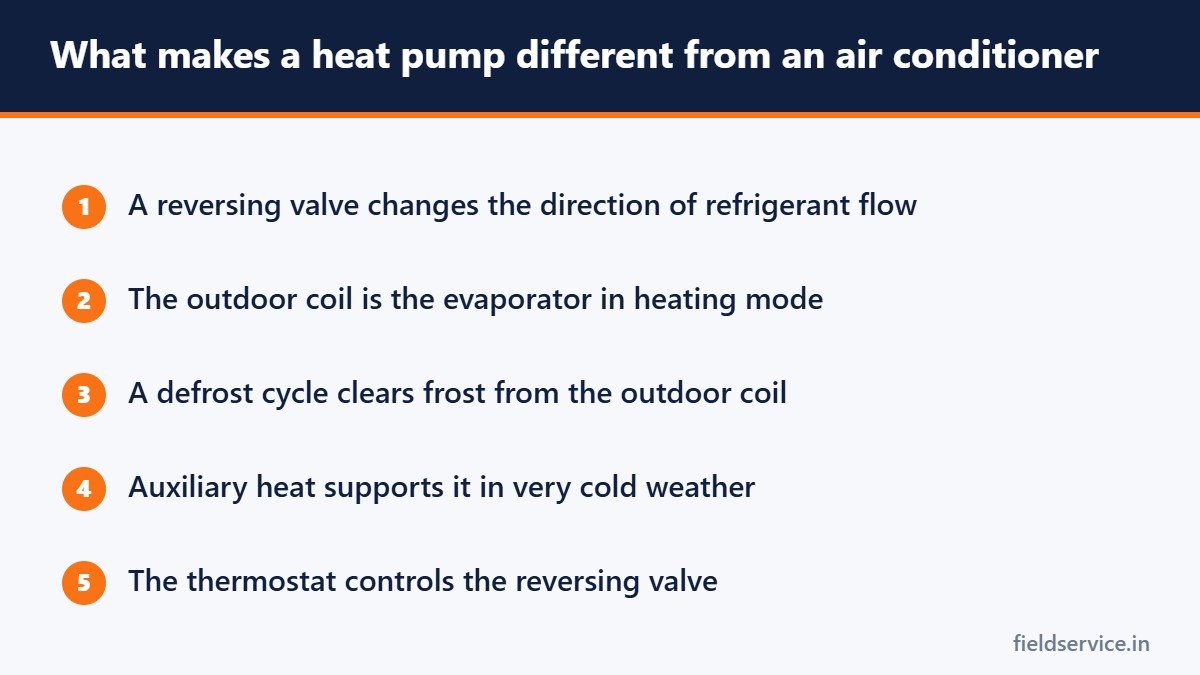
In heating, the roles swap. The outdoor coil becomes the evaporator and absorbs heat from outdoor air. The indoor coil becomes the condenser and releases that heat into the house.
The reversing valve
The component that makes this possible is the reversing valve, a four-way valve operated by a solenoid. It redirects the hot gas leaving the compressor to either the outdoor coil or the indoor coil. The thermostat energizes the solenoid through the O or B terminal. Most brands energize the valve in cooling, using O. A few energize it in heating, using B. Setting this wrongly on a thermostat makes the system cool when it should heat.
The defrost cycle
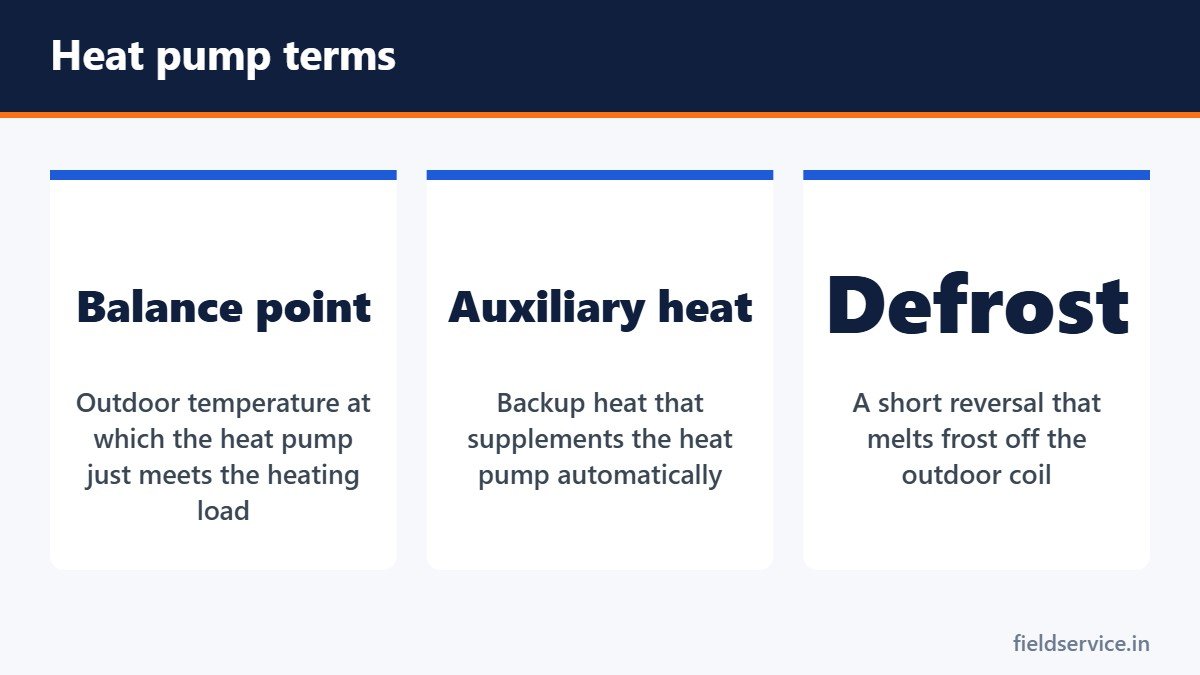
In heating mode the outdoor coil runs colder than the outdoor air. In cool, damp weather, moisture freezes on it, and the frost blocks airflow. To clear it, the system briefly switches to cooling mode, sends hot gas to the outdoor coil and stops the outdoor fan. Auxiliary heat usually comes on so that the house does not get cold air. The frost melts, often with a cloud of steam, and the system returns to heating.
Customers call about this regularly. Steam from the outdoor unit and a whooshing sound for a few minutes on a cold morning are normal. A coil that stays encased in ice is not.
Auxiliary and emergency heat
As the outdoor temperature falls, a heat pump’s capacity falls and the house’s heat loss rises. The outdoor temperature at which the heat pump can only just keep up is called the balance point. Below it, the system needs help.
- Auxiliary heat is additional heat, usually electric resistance strips in the air handler, that comes on automatically to supplement the heat pump and during defrost.
- Emergency heat is a thermostat setting that turns the heat pump off and runs the backup heat alone. It is meant for when the heat pump has failed, and it is costly to run on electric resistance.
- Dual fuel systems pair a heat pump with a gas furnace, which takes over in colder weather.
Efficiency ratings
- SEER2 rates cooling efficiency over a season.
- HSPF2 rates heating efficiency over a season.
- COP, the coefficient of performance, is the heat delivered divided by the electrical energy used at a given condition. A COP of 3 means three units of heat for each unit of electricity.
Higher numbers mean greater efficiency. Many newer heat pumps use variable-speed, inverter-driven compressors, and models designed for cold climates keep much more of their capacity at low outdoor temperatures than older designs did.
“It is blowing cold air”
The supply air from a heat pump is cooler than the air from a gas furnace, though it is still warmer than the room. Customers used to a furnace sometimes report it as a fault. Measure the supply and return temperatures before assuming anything is wrong. Our article on temperature split explains the measurement.
Faults technicians see most often
- Reversing valve. A failed solenoid coil, a valve stuck in one position, or a valve leaking internally, which shows as poor capacity in both modes.
- Defrost problems. A failed defrost control board or sensor leaves the coil iced over, or causes defrosts that are too frequent.
- Low refrigerant charge. Often noticed first in heating. Find and repair the leak.
- Outdoor fan motor or capacitor. See how to test a run capacitor.
- Auxiliary heat faults. A failed sequencer, element or limit means no heat during defrost and in cold weather. Strips that stay on drive up the electric bill.
- Thermostat set up wrongly for the reversing valve or for the type of backup heat.
- Restricted airflow from a dirty filter or coil, which causes high pressures in heating.
Service points
- Charging in heating mode is different from charging in cooling. Follow the manufacturer’s charging instructions for the mode and conditions. See superheat and subcooling explained.
- Test the system in both modes, whatever the season of the visit.
- Check that the outdoor unit is raised above the expected snow level and that defrost water can drain away.
- Check auxiliary heat operation and its amp draw.
- Confirm the thermostat is configured for a heat pump with the right backup heat type.
Maintenance customers should know about
- Change or clean filters regularly.
- Keep the outdoor unit clear of leaves, snow and ice.
- Do not chip ice off the coil.
- Avoid large thermostat setbacks in winter, which can bring on the auxiliary heat.
Newer heat pumps use A2L refrigerants. See our guide to the R-410A rule change.
Related guides
- Maintenance Agreements: How They Work and How to Price Them
- Spiffs and Bonuses for Technicians: How They Work and How They Affect Overtime
- Condensate Drain Problems: Causes, Fixes and Prevention
Six everyday forms in Word and PDF, plus Excel workbooks that total mileage reimbursement and overtime pay.
Not sure yet? Try two forms free or see all packs.
Frequently asked questions
How does a heat pump heat a house when it is cold outside?
Outdoor air contains heat energy even when it is cold. The refrigerant in the outdoor coil absorbs that heat and the system releases it indoors. Capacity falls as the temperature drops, which is why backup heat is provided.
Why is my heat pump steaming in winter?
That is the defrost cycle. The system briefly reverses to melt frost from the outdoor coil, and the melting frost produces steam. It normally lasts a few minutes.
What is the difference between auxiliary heat and emergency heat?
Auxiliary heat comes on automatically to supplement the heat pump in cold weather and during defrost. Emergency heat is a manual setting that turns the heat pump off and runs only the backup heat.
What does the O/B terminal do on a heat pump thermostat?
It controls the reversing valve. Most brands energize the valve in cooling using O, and some energize it in heating using B.
This article is an educational overview. Follow the equipment manufacturer’s installation and service instructions.