


There are two main ways to learn a skilled trade. You can pay a school to teach you the fundamentals and then look for work, or you can be hired as an apprentice and learn on the job while taking classes. Both lead to the same licenses and the same careers. They differ in cost, speed, how you learn and how hard it is to get started. Many people end up doing some of each.
How trade school works
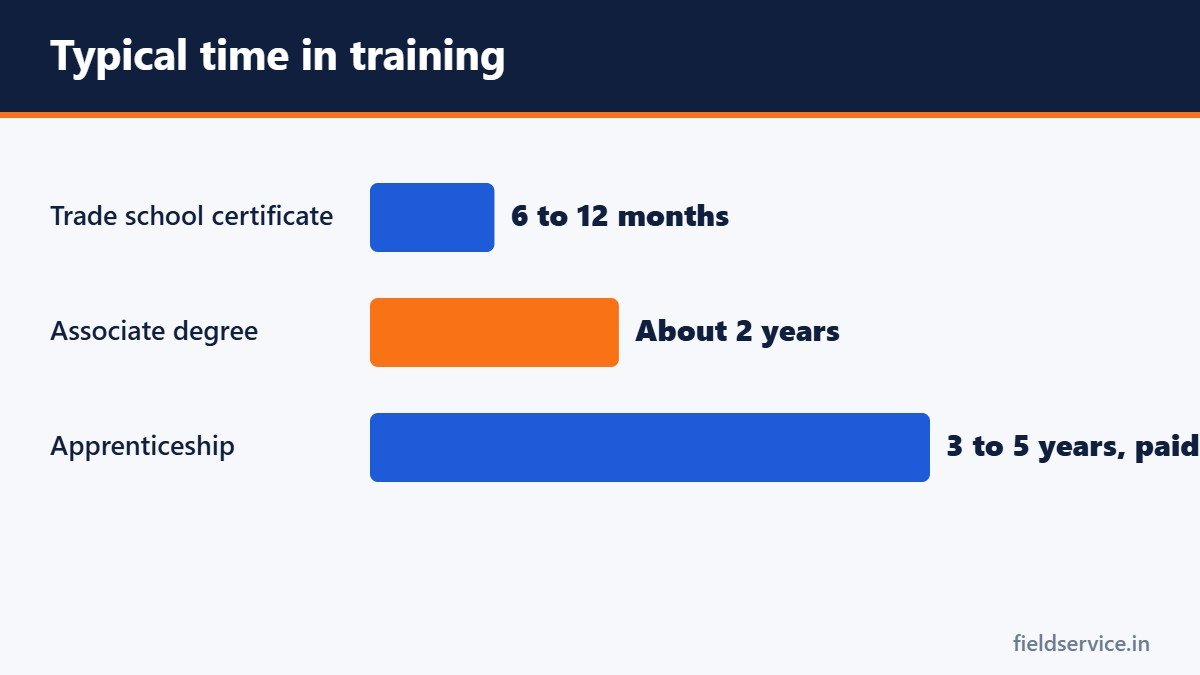
Trade schools, technical colleges and community colleges offer certificate and associate degree programs in HVAC, electrical technology, plumbing and related fields. Programs commonly run from about six months to two years. You study theory in a classroom and practice in a lab on training equipment. You pay tuition, and you graduate with a credential and little or no field experience.
- Advantages: you can usually start soon, the teaching is structured, and you gain a foundation in theory that makes field learning faster.
- Disadvantages: it costs money, you are not earning while you study full time, and employers will still treat you as a beginner.
How an apprenticeship works
An apprentice is an employee. You work under experienced tradespeople, are paid from the first day and attend related classroom instruction, often in the evenings or in blocks. Apprenticeships typically last three to five years, depending on the trade. Wages start at a percentage of the journeyman rate and rise as you progress. At the end you are qualified to sit the licensing exam where one is required.
Programs registered with the U.S. Department of Labor or a state apprenticeship agency meet set standards and lead to a nationally recognized credential.
- Advantages: you earn while you learn, tuition is low or paid by the sponsor, and you finish with years of real experience.
- Disadvantages: places can be competitive, the commitment is long, and you work full time while studying.
| Factor | Trade school | Apprenticeship |
|---|---|---|
| Typical length | 6 months to 2 years | 3 to 5 years |
| Cost to you | Tuition, tools and living costs | Little or none |
| Pay while training | None, unless you work part time | A wage that rises each year |
| How you learn | Classroom and lab | On the job, plus classes |
| Experience at the end | Limited | Several years |
| Getting in | Usually open enrollment | Application, often competitive |
The trade matters
- Electrical and plumbing. Apprenticeship is the standard route in most states, because licensing depends on documented work hours under a licensed tradesperson. School can still help you get hired and may count toward the classroom requirement.
- HVAC. A certificate from a trade school is a common starting point, and many employers hire graduates directly. Apprenticeships are also available.
See our guides to becoming an HVAC technician, an electrician or a plumber, and our comparison of the three trades.
Doing both
The two routes are not exclusive. A common path is a short certificate program followed by an apprenticeship or an entry-level job. Some states and programs give credit for school hours toward apprenticeship requirements. Ask before you enroll, because the rules differ and the credit is not guaranteed.
Questions to ask a trade school
- What is the total cost, including tools, books and fees?
- Is the school accredited, and does the program qualify for federal financial aid?
- What share of students finish the program?
- What share of graduates are working in the trade, and where?
- Do local contractors hire from the program?
- Does the program prepare for and include certification exams, such as EPA Section 608 for HVAC?
- Will the hours count toward licensing or apprenticeship requirements in my state?
Be careful with programs that are expensive, make large promises about earnings or push you to sign quickly. Community college programs often cost much less than private schools for similar content.
Questions to ask about an apprenticeship
- Is the program registered with the Department of Labor or the state?
- How long is it, and what is the wage at each stage?
- Who pays for the classroom instruction?
- What are the entry requirements and the application dates?
- How many apprentices complete the program?
- What happens if work slows down?
Which route suits whom
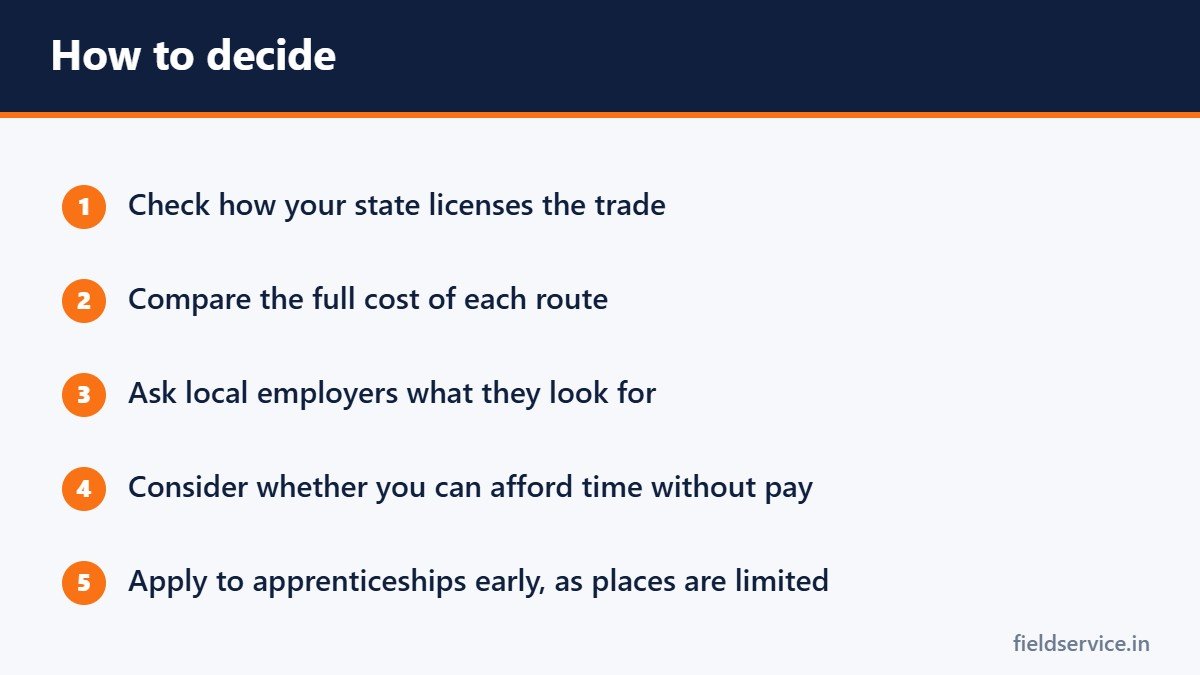
- Trade school first suits people who want to start quickly, learn well in a classroom, are changing careers, or cannot find an apprenticeship place nearby.
- Apprenticeship suits people who need to earn from the start, learn best by doing and can commit for several years.
- A helper job with a contractor is a third way in for people who want to test the trade before committing to either.
Paying for training
Accredited schools may qualify for federal financial aid, and many states, unions, employers and industry groups offer scholarships and grants for trade training. Veterans may be able to use their education benefits for approved programs, including apprenticeships. Some employers reimburse tuition for employees who complete a program.
How to find an apprenticeship
- Search the federal government’s apprenticeship site for registered programs in your area.
- Contact local union training centers and contractor associations.
- Call contractors directly and ask whether they sponsor apprentices.
- Prepare for the aptitude test if there is one. Basic algebra and reading are the usual subjects.
- Get a driver’s license and keep your record clean.
To see what an apprentice wage or a starting rate adds up to, use the hourly to annual pay calculator. For how the license levels work once you are in, see apprentice, journeyman and master.
Six everyday forms in Word and PDF, plus Excel workbooks that total mileage reimbursement and overtime pay.
Not sure yet? Try two forms free or see all packs.
Frequently asked questions
Is trade school or an apprenticeship better?
Neither is better for everyone. Apprenticeships pay you while you train and include years of experience. Trade school is faster to start and gives a strong grounding in theory. For electrical and plumbing, apprenticeship is the standard route to a license in most states.
Do apprentices get paid?
Yes. Apprentices are employees and earn a wage that rises as they progress through the program.
Can trade school count toward an apprenticeship?
Sometimes. Some states and programs give credit for school hours. Ask the apprenticeship sponsor or the state licensing board before you enroll.
How do I find a registered apprenticeship?
Search the federal government’s apprenticeship website, and contact local union training centers, contractor associations and individual contractors.
Related guides
- Field Service Career Paths: Where the Trades Can Take You
- What Is a Trip Charge and How Should You Set One?
- How to Ask for a Raise as a Field Technician