


Every technician who connects equipment to power needs to know whether the wire feeding it is big enough. A conductor that is too small for its load overheats, and overheated wiring is a leading cause of electrical fires. The relationship between wire size and the current it can carry safely is called ampacity. The basics are simple, and the details are where mistakes happen.
How wire gauge works
In the United States, wire size is given in American Wire Gauge, or AWG. The scale runs backward: the smaller the number, the larger the wire. A 10 AWG conductor is thicker than a 14 AWG conductor and can carry more current. Sizes larger than 1 AWG are written 1/0, 2/0, 3/0 and 4/0, and beyond that they are measured in kcmil.
What ampacity means
Ampacity is the maximum current a conductor can carry continuously, under the conditions in which it is installed, without exceeding its temperature rating. It depends on the conductor material, the size, the insulation type and the surroundings.
Common copper sizes and breaker pairings
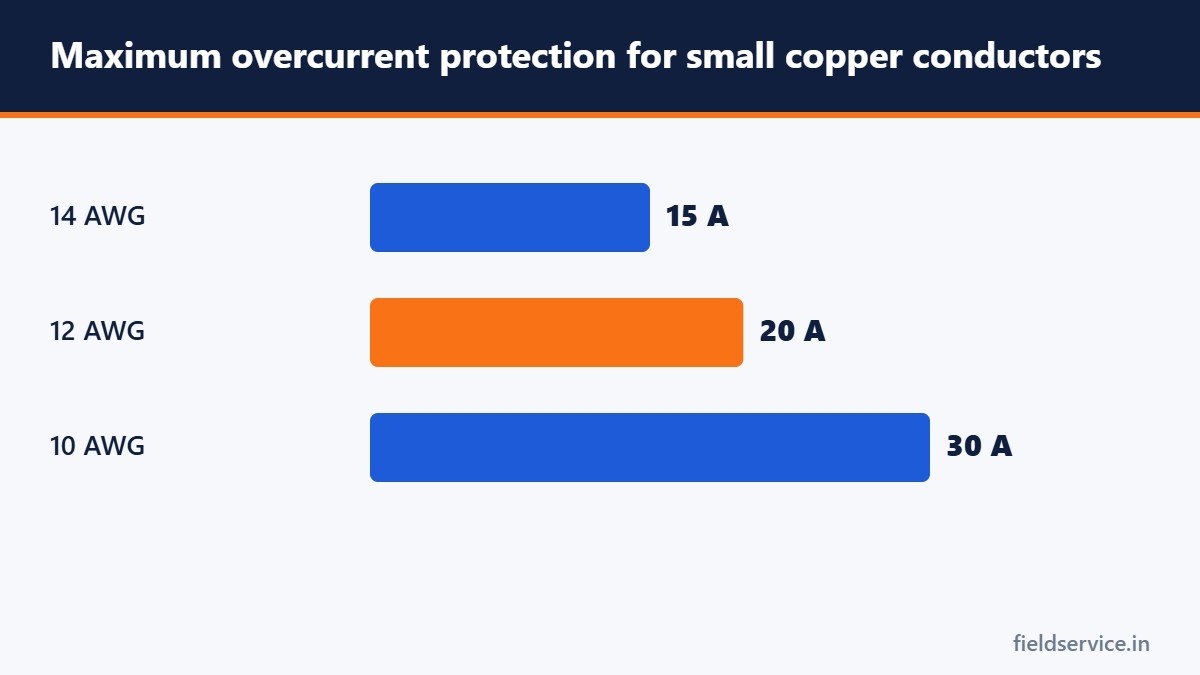
For the small conductors used in most branch circuits, the National Electrical Code limits the overcurrent protection as follows:
| Copper wire size | Maximum breaker or fuse | Typical use |
|---|---|---|
| 14 AWG | 15 amps | Lighting and general receptacles |
| 12 AWG | 20 amps | Kitchen, bathroom and general receptacles |
| 10 AWG | 30 amps | Water heaters, dryers, small air conditioners |
For larger conductors, ampacity comes from the code’s ampacity tables and depends on the temperature rating used. As examples from the 60°C and 75°C columns for copper: 8 AWG is listed at 40 and 50 amps, and 6 AWG at 55 and 65 amps. Always work from the current edition of the code adopted in your area.
What changes ampacity
- Conductor material. Aluminum carries less current than copper of the same size, so aluminum conductors must be larger for the same load.
- Termination temperature rating. The lugs and terminals on breakers and equipment have temperature ratings, commonly 60°C or 75°C. The conductor’s ampacity must be taken from the column that matches the lowest-rated termination, even when the wire insulation is rated higher.
- Ambient temperature. Wire in a hot attic or on a roof cannot shed heat as well. The code applies correction factors that reduce ampacity.
- Bundling. More than three current-carrying conductors in one raceway or cable heat one another, and adjustment factors apply.
- Continuous loads. A load expected to run for three hours or more is treated as 125 percent of its current when sizing conductors and overcurrent protection.
Reading an HVAC nameplate
Air conditioners and heat pumps are a special case, and they confuse people who know the general rules. The nameplate gives two figures:
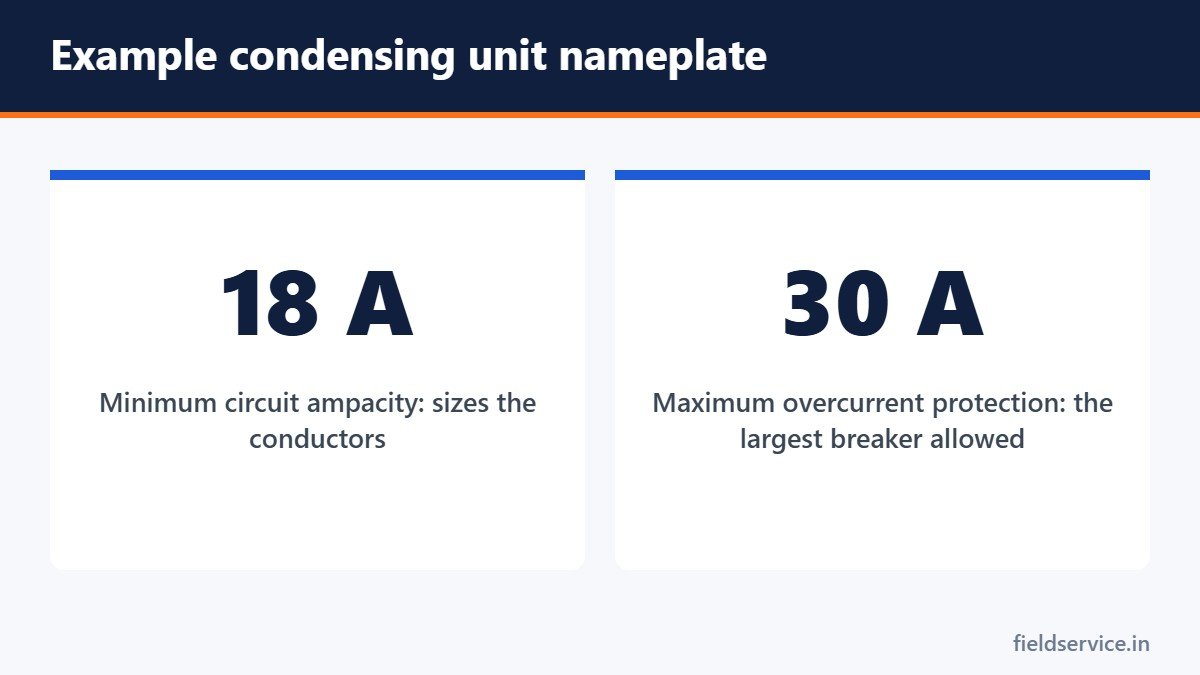
- Minimum circuit ampacity (MCA). The conductors must have at least this ampacity.
- Maximum overcurrent protection (MOCP), sometimes shown as maximum fuse or breaker size. The breaker or fuse must not be larger than this.
For this equipment the breaker is often larger than the usual pairing for the wire size. A condensing unit with an MCA of 18 amps and an MOCP of 30 amps can be wired with conductors sized for 18 amps and protected by a 30-amp breaker. This is permitted because the unit has its own overload protection, and the larger breaker allows for the compressor’s starting current. Size the wire from MCA and the breaker from MOCP, and follow the nameplate.
Ampacity is not the only check
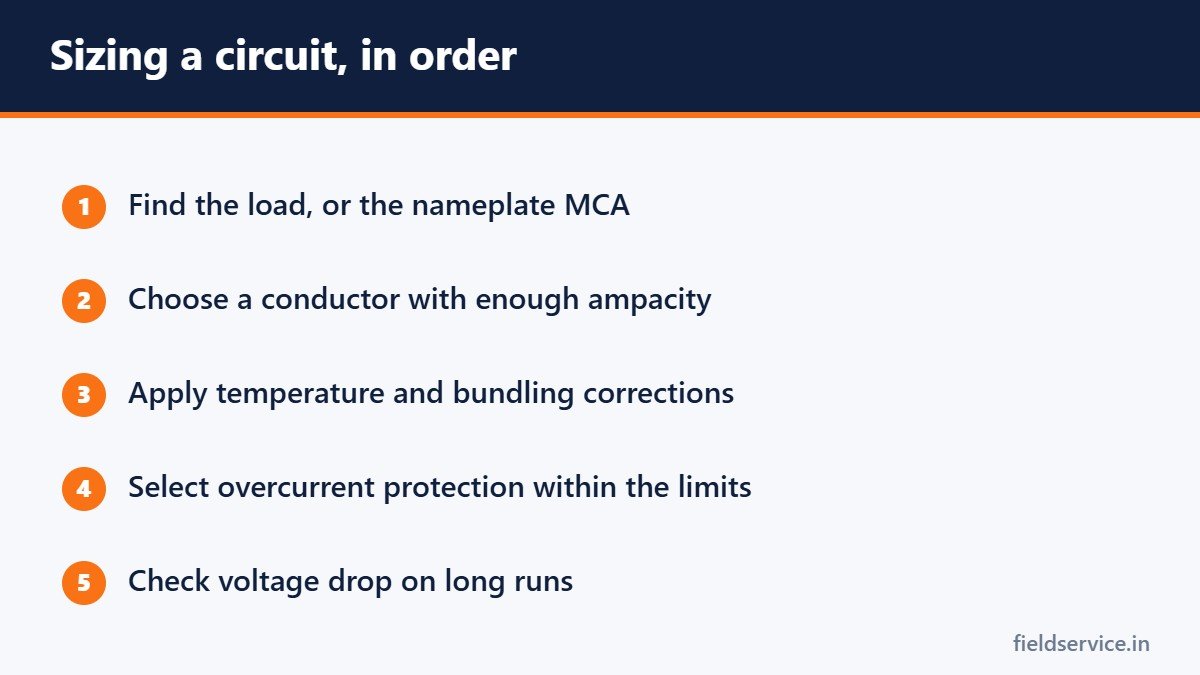
A conductor can be large enough to carry the current safely and still lose too much voltage over a long run. On long circuits, check voltage drop as a second step and increase the wire size if needed. See voltage drop explained.
Mistakes seen in the field
- Replacing a breaker with a larger one because it keeps tripping, without checking the wire size
- Sizing wire from the insulation’s 90°C rating when the terminals are rated 60°C or 75°C
- Ignoring attic or rooftop temperatures
- Using copper ampacities for aluminum conductors
- Sizing an HVAC circuit from the breaker in place and not from the nameplate
- Extending a circuit with smaller wire than the original
A breaker that trips is doing its job. The right response is to find out why, starting with a current reading under load. See how to use a multimeter.
How to identify a wire size
- Read the printing on the cable jacket or the conductor insulation.
- Use a wire gauge tool or the stripping notches on a pair of wire strippers.
- Do not judge by eye. Insulation thickness varies, and two sizes can look alike.
For non-electricians
HVAC, appliance and plumbing technicians regularly connect equipment to existing circuits. You do not need to design the installation, but you should be able to read the nameplate, identify the wire size and breaker serving the equipment, and recognize when they do not match. When they do not, tell the customer and recommend a licensed electrician. In many places, installing or altering a circuit requires an electrical license and a permit.
For the underlying relationships, see Ohm’s law for technicians.
Related guides
- Furnace Tune-Up Checklist: What a Technician Should Check
- R-410A in 2026: What the EPA Rule Change Means for HVAC Technicians
- Heat Pump Basics: How They Work and What Goes Wrong
Six everyday forms in Word and PDF, plus Excel workbooks that total mileage reimbursement and overtime pay.
Not sure yet? Try two forms free or see all packs.
Frequently asked questions
What size wire do I need for a 20-amp circuit?
For copper conductors on a typical branch circuit, 12 AWG is the size paired with 20-amp overcurrent protection. Long runs may need a larger size to limit voltage drop.
Why can an air conditioner have a 30-amp breaker on smaller wire?
For air conditioning and heat pump equipment, conductors are sized from the nameplate minimum circuit ampacity and the breaker from the maximum overcurrent protection. The unit’s own overload protection allows the breaker to be larger than the usual pairing.
Does aluminum wire have the same ampacity as copper?
No. Aluminum carries less current than copper of the same size, so a larger aluminum conductor is needed for the same load.
Is a lower AWG number a bigger wire?
Yes. The AWG scale runs backward, so 10 AWG is larger than 14 AWG.
This article is an educational overview. Electrical work must follow the code adopted in your area and should be done by a qualified, licensed person.