

If you have decided on a skilled trade but not on which one, three choices come up more than any others: heating and air conditioning, electrical and plumbing. All three pay well above the median wage, all three are short of workers, and all three let you earn while you train. They differ in how you get in, what the days feel like and where the work leads. This comparison uses current figures from the U.S. Bureau of Labor Statistics.
Pay and job outlook
| Measure | HVAC technician | Electrician | Plumber |
|---|---|---|---|
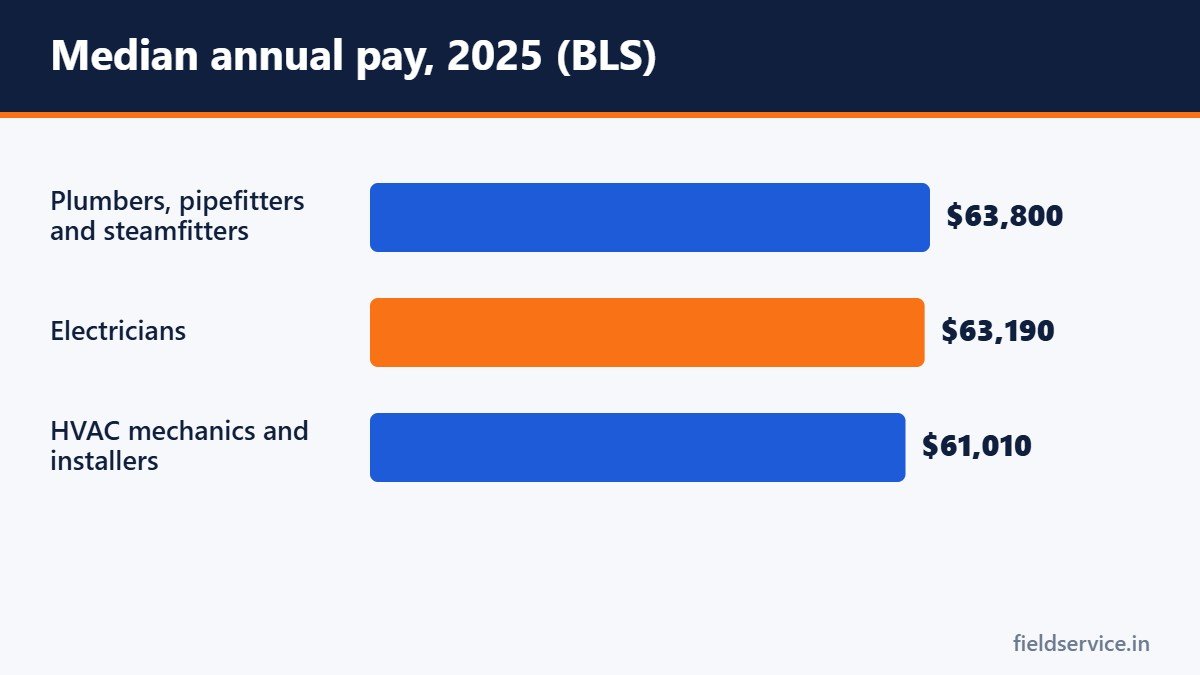
| Median pay, 2025 | $61,010 | $63,190 | $63,800 |
| Median hourly pay | $29.33 | $30.38 | $30.67 |
| Jobs, 2025 | 440,900 | 821,000 | 510,600 |
| Projected growth, 2025 to 2035 | 11% | 9% | 7% |
| Projected openings each year | 40,600 | 72,700 | 42,000 |
The plumber column covers plumbers, pipefitters and steamfitters together. The median figures are within about $2,800 of one another, so pay alone should not decide it. Local demand, union density and specialty make more difference than the national median. The top 10 percent in each trade earn more than $95,000, and for electricians and plumbers more than $108,000.
How you get in
HVAC
The BLS lists a postsecondary nondegree award as the typical entry point, meaning a certificate from a trade school or community college, usually six months to two years. Apprenticeships exist too, and some people start as helpers. EPA Section 608 certification is required to handle refrigerant. See how to become an HVAC technician.
Electrical
The standard route is a four to five-year apprenticeship that combines paid work with classroom instruction, leading to a journeyman license. Entry is often competitive and may include an aptitude test with algebra. See how to become an electrician.
Plumbing
Also a four to five-year apprenticeship in most cases, leading to a journeyman license and later a master license. See how to become a plumber.
Licensing
Electricians and plumbers are licensed in most states under an apprentice, journeyman and master structure. HVAC licensing varies more. Some states license individual technicians, and others license only the contractor. In every state the rules are local, and a license from one state does not automatically carry to another. Our article on trade levels explains the structure.
What the work is like
HVAC
HVAC is the broadest of the three. A technician deals with refrigeration, airflow, combustion, electrical circuits and controls, often in one call. Much of the work is diagnostic. It is also the most seasonal: long hours in summer and winter, quieter in spring and fall. Expect attics, rooftops and crawl spaces.
Electrical
Electrical work leans toward installation in new construction and remodels, with service and troubleshooting as a smaller share. It is precise and code-driven. The work is generally cleaner than the other two, and the main hazard, electric shock and arc flash, is one you cannot see. Demand is steady through the year.
Plumbing
Plumbing combines installation with a large amount of repair. Service plumbers are called to emergencies at all hours, and some of the work involves drains and sewage. It is physically demanding. Demand is steady, and emergency work pays well.
| Factor | HVAC | Electrical | Plumbing |
|---|---|---|---|
| Typical training | Certificate, 6 months to 2 years, or apprenticeship | Apprenticeship, 4 to 5 years | Apprenticeship, 4 to 5 years |
| Seasonality | High | Low | Low |
| Share of diagnostic work | High | Moderate | Moderate to high |
| Main physical demands | Attics, roofs, heat | Ladders, conduit, crawl spaces | Lifting, crawling, wet work |
| Emergency call-outs | Seasonal peaks | Less frequent | Year-round |
Which suits you?
- You enjoy working out why something does not work: HVAC service offers the most troubleshooting.
- You like precise, methodical installation and are comfortable with math: electrical is a strong fit.
- You want steady year-round demand and do not mind dirty work: plumbing is hard to beat.
- You want the fastest route to a paycheck in the field: an HVAC certificate program is usually the shortest.
- You want the most structured path and the widest range of settings: an electrical apprenticeship.
Where each trade is heading
All three are being reshaped by electrification and efficiency rules. Heat pumps are bringing HVAC and electrical work closer together. New refrigerants are changing HVAC service practice, as we explain in our guide to the R-410A rule change. Electric vehicle charging, solar and battery storage are adding electrical work. Water heating is moving toward heat pump water heaters, which involve plumbing, electrical and refrigeration skills together. Technicians who understand more than one trade will be in demand.
You are not locked in
Skills carry across. Many HVAC technicians hold an electrical license, plumbers often move into hydronic heating and gas work, and facilities maintenance roles use all three. Starting in one trade does not prevent a move later, and a second credential usually raises your pay.
A practical way to decide
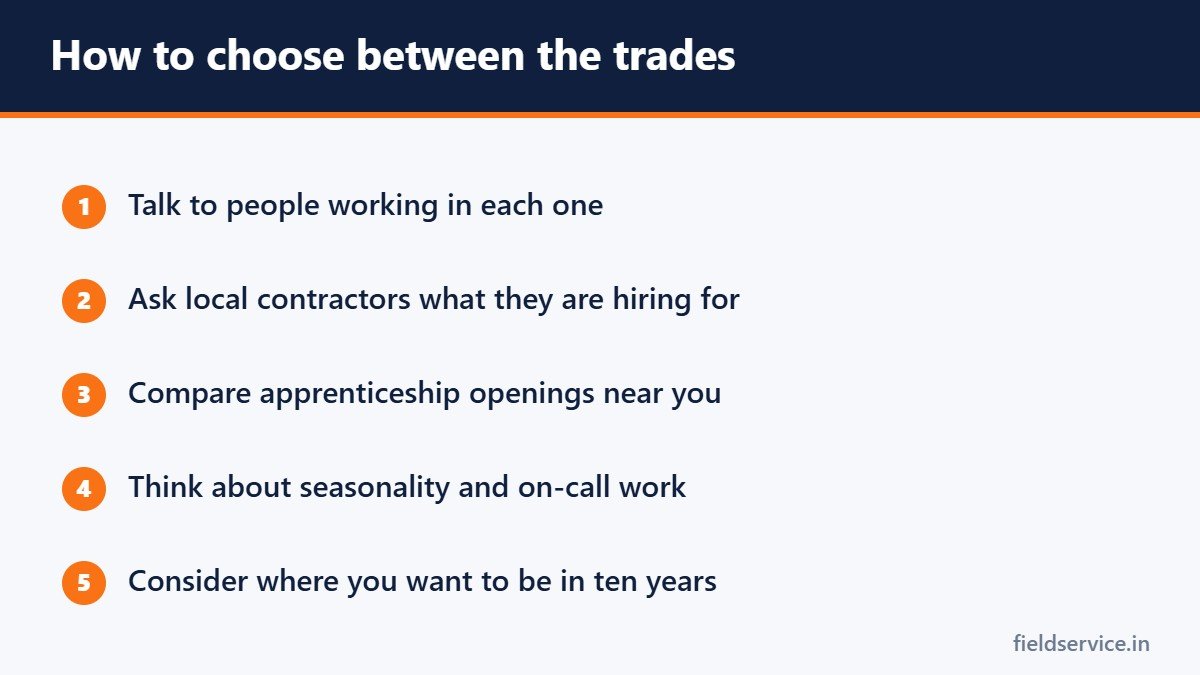
- Ask to ride along for a day with a technician in each trade. Many contractors will agree.
- Look at which apprenticeships and schools are within reach of where you live.
- Check your state’s licensing rules for each trade.
- Compare starting wages locally, not nationally.
- Choose the one where the daily work appeals to you. The pay is close enough that enjoyment should decide.
To see what a wage comes to across a year, use the hourly to annual pay calculator. For where any of these trades can lead, see field service career paths.
Six everyday forms in Word and PDF, plus Excel workbooks that total mileage reimbursement and overtime pay.
Not sure yet? Try two forms free or see all packs.
Frequently asked questions
Which trade pays the most: HVAC, electrician or plumber?
National median pay in 2025 was $63,800 for plumbers, pipefitters and steamfitters, $63,190 for electricians and $61,010 for HVAC mechanics and installers, according to the Bureau of Labor Statistics. Local demand and specialty matter more than these small differences.
Which trade is growing fastest?
The BLS projects 11 percent growth for HVAC mechanics and installers from 2025 to 2035, 9 percent for electricians and 7 percent for plumbers, pipefitters and steamfitters.
Which trade is quickest to get into?
HVAC usually has the shortest formal training, with certificate programs of six months to two years. Electrical and plumbing apprenticeships typically take four to five years, though you are paid throughout.
Can I switch trades later?
Yes. Many skills transfer, and technicians often add a second license or certification. Some states give credit for related experience.
Related guides
- Trade School vs. Apprenticeship: Which Route Into the Trades Is Right for You?
- Superheat and Subcooling Explained for HVAC Technicians
- How to Ask for a Raise as a Field Technician