

A compressor that struggles to start, lights that dim when a motor kicks in, a control board that resets for no clear reason. Problems like these are often traced to voltage drop: the equipment is receiving less voltage than the panel is supplying, because some of it has been lost along the way. The loss is predictable, it can be calculated before a wire is pulled, and it can be measured with an ordinary meter.
What voltage drop is
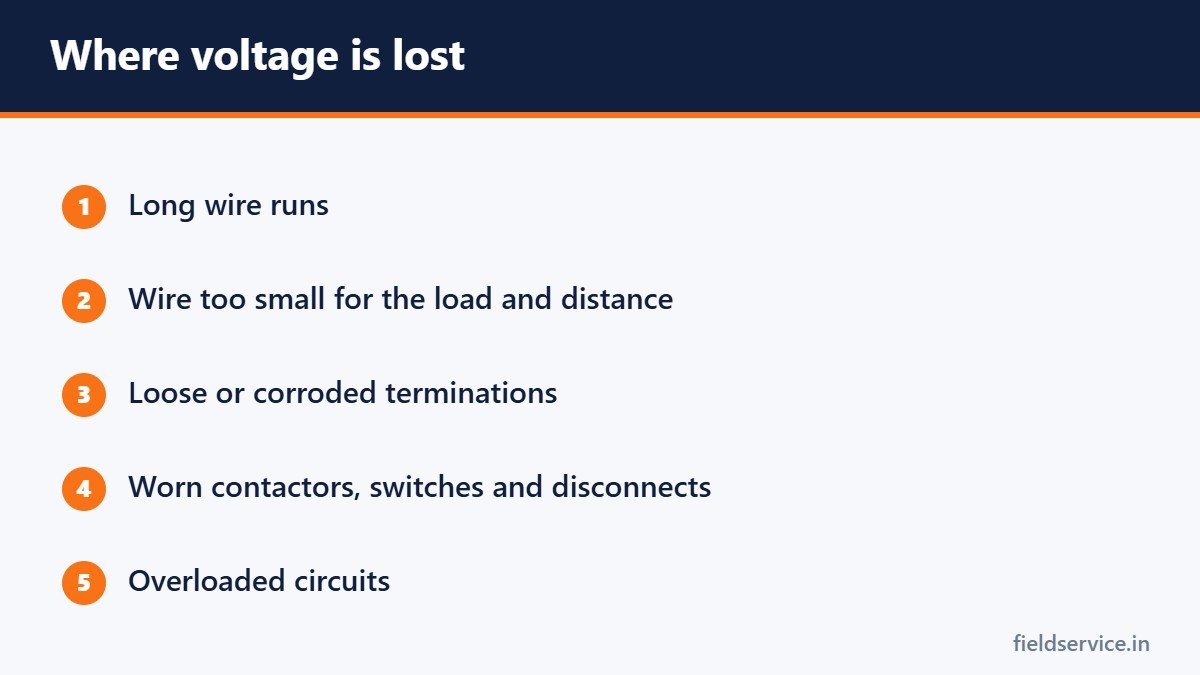
Every conductor has resistance. When current flows through it, some voltage is used up pushing the current through the wire itself. By Ohm’s law, the voltage lost equals the current multiplied by the resistance of the wire. That voltage never reaches the load. It turns into heat in the conductor.
Three things increase it:
- More current. A heavier load loses more voltage in the same wire.
- A longer run. Resistance rises with length.
- A smaller wire. Thinner conductors have more resistance per foot.
How to calculate it
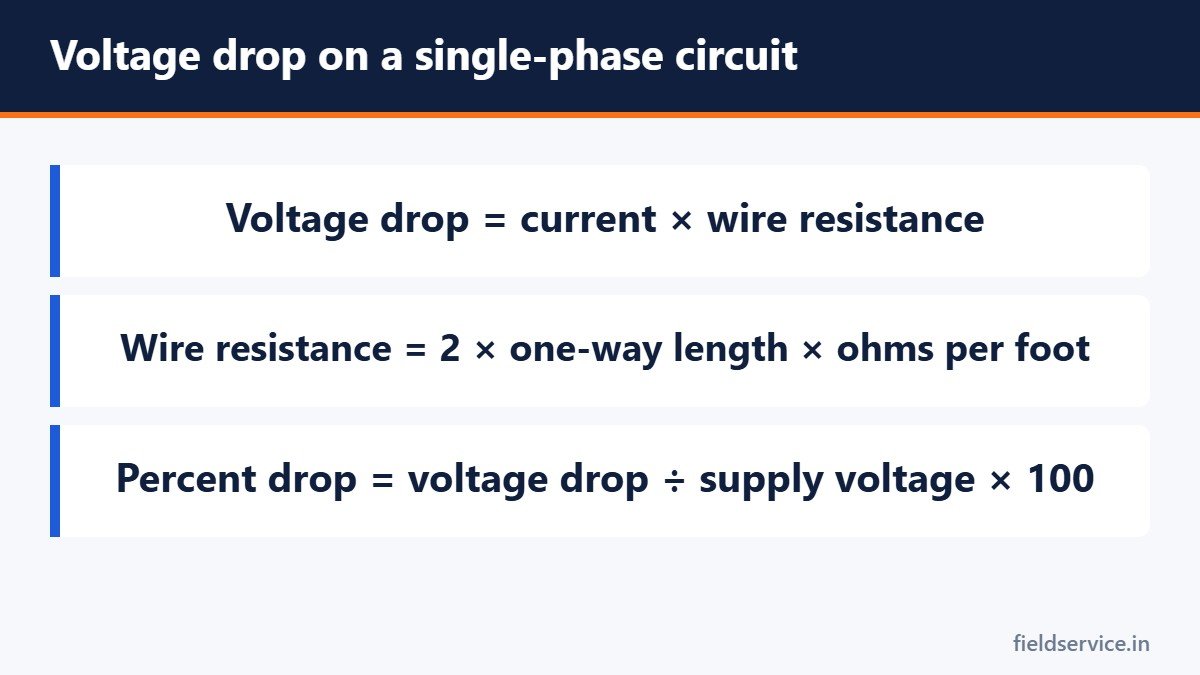
On a single-phase circuit the current travels out and back, so the length of wire is twice the one-way distance. Multiply that length by the resistance of the wire per foot, then multiply by the current.
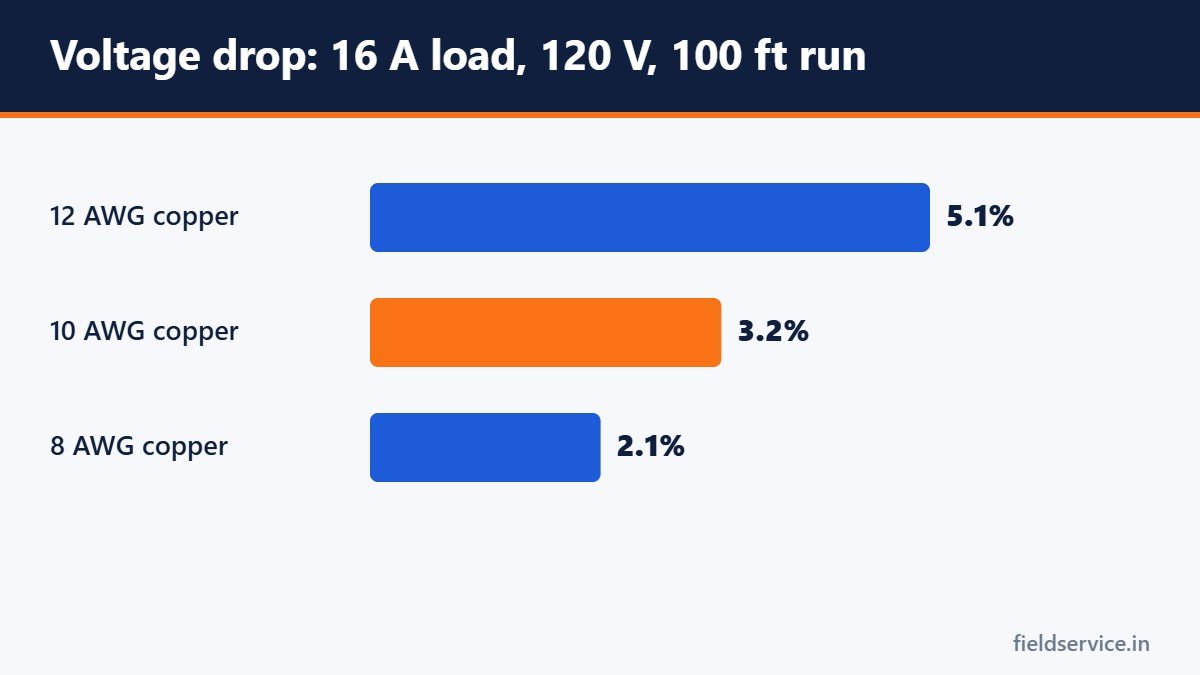
Example: a 16-amp load on a 120-volt circuit, 100 feet from the panel, wired in 12 AWG copper. The resistance of 12 AWG copper is roughly 1.93 ohms per 1,000 feet.
- Wire length: 2 × 100 = 200 feet
- Resistance: 200 × 1.93 ÷ 1,000 = 0.386 ohms
- Voltage drop: 16 × 0.386 = 6.2 volts
- Percent: 6.2 ÷ 120 = 5.1 percent
The load receives about 113.8 volts.
The commonly recommended limits
The National Electrical Code includes informational notes recommending that voltage drop be kept to 3 percent on a branch circuit, and 5 percent for the feeder and branch circuit combined, for reasonable efficiency of operation. In most situations these are recommendations and not enforceable rules, though some codes, energy standards and equipment manufacturers do set firm requirements. Always check the code adopted in your area and the equipment’s installation instructions.
The example above, at 5.1 percent, is well over the 3 percent guideline.
Fixing it at the design stage
Using the same load and distance with larger wire:
- 10 AWG copper, about 1.21 ohms per 1,000 feet: 3.9 volts, or 3.2 percent
- 8 AWG copper, about 0.78 ohms per 1,000 feet: 2.5 volts, or 2.1 percent
Increasing the conductor size is the usual answer for long runs. Other options are shortening the run, moving the load to a higher voltage where the equipment allows, or reducing the load on the circuit. When circuit conductors are increased in size, the code has requirements about increasing the equipment grounding conductor as well.
What voltage drop does to equipment
- Motors and compressors draw more current at low voltage, run hotter and can fail to start.
- Heating elements produce less heat.
- Electronics and controls can reset, lock out or behave erratically.
- Lighting dims or flickers.
- The wiring itself wastes energy as heat.
Most equipment nameplates list an acceptable voltage range. A reading outside that range at the unit while it is running is a problem, whatever the panel shows.
The other cause: bad connections
Undersized wire is only one source. A loose lug, a corroded splice, a worn contactor or a burnt disconnect adds resistance at a single point. That point behaves like a small heater. It takes voltage from the load and gets hot, which is why failing connections discolor and burn.
Finding it with a meter
- Measure the voltage at the source, such as the panel or disconnect, with the load running.
- Measure the voltage at the equipment terminals with the load running.
- The difference is the voltage drop in between.
- To find a bad connection, measure across it while the circuit is under load. Put one probe on each side of the connection. A sound connection reads close to zero. A reading of more than a fraction of a volt means resistance at that point.
These measurements are taken on live circuits. They should be done only by trained people using properly rated meters and protective equipment. See how to use a multimeter.
A point that catches people out
Voltage measured with the load switched off tells you nothing about voltage drop. With no current flowing, there is no drop, and a circuit with a serious fault can show full voltage. Always measure with the equipment running, and for motors, watch what happens at the moment of starting, when current is at its highest.
Voltage drop and wire sizing
Wire is first sized for ampacity, so that it can carry the current safely without overheating. Voltage drop is a second check that matters on long runs. A conductor can be perfectly legal for ampacity and still deliver poor voltage at the far end of a long circuit. Our guide to wire gauge and ampacity covers the first step.
Related guides
- Condensate Drain Problems: Causes, Fixes and Prevention
- Furnace Tune-Up Checklist: What a Technician Should Check
- Heat Pump Basics: How They Work and What Goes Wrong
Six everyday forms in Word and PDF, plus Excel workbooks that total mileage reimbursement and overtime pay.
Not sure yet? Try two forms free or see all packs.
Frequently asked questions
What is an acceptable voltage drop?
The National Electrical Code’s informational notes recommend no more than 3 percent on a branch circuit and 5 percent for the feeder and branch circuit combined. Check the code adopted in your area and the equipment manufacturer’s requirements.
How do I calculate voltage drop?
For a single-phase circuit, multiply the current by the resistance of the wire, using twice the one-way length because the current travels out and back. Divide by the supply voltage to get a percentage.
Why must voltage drop be measured under load?
With no current flowing there is no voltage drop, so a faulty circuit can show full voltage when the load is off. Measure with the equipment running.
Can a loose connection cause voltage drop?
Yes. A loose or corroded connection adds resistance at one point, which takes voltage from the load and produces heat at the connection.
This article is an educational overview. Electrical work must follow the code adopted in your area and should be done by a qualified person.