

Pressure readings alone do not tell you whether an air conditioner is charged correctly. Two systems can show the same pressures and behave very differently. Superheat and subcooling add temperature to the picture, and together they show what the refrigerant is doing in the evaporator and the condenser. They are among the first measurements a new HVAC technician needs to understand.
Saturation, in brief
At a given pressure, a refrigerant boils and condenses at one particular temperature, called the saturation temperature. A pressure-temperature (PT) chart, or a digital gauge set, converts a pressure reading into that temperature. While liquid and vapor exist together, the refrigerant stays at saturation temperature.
What superheat is
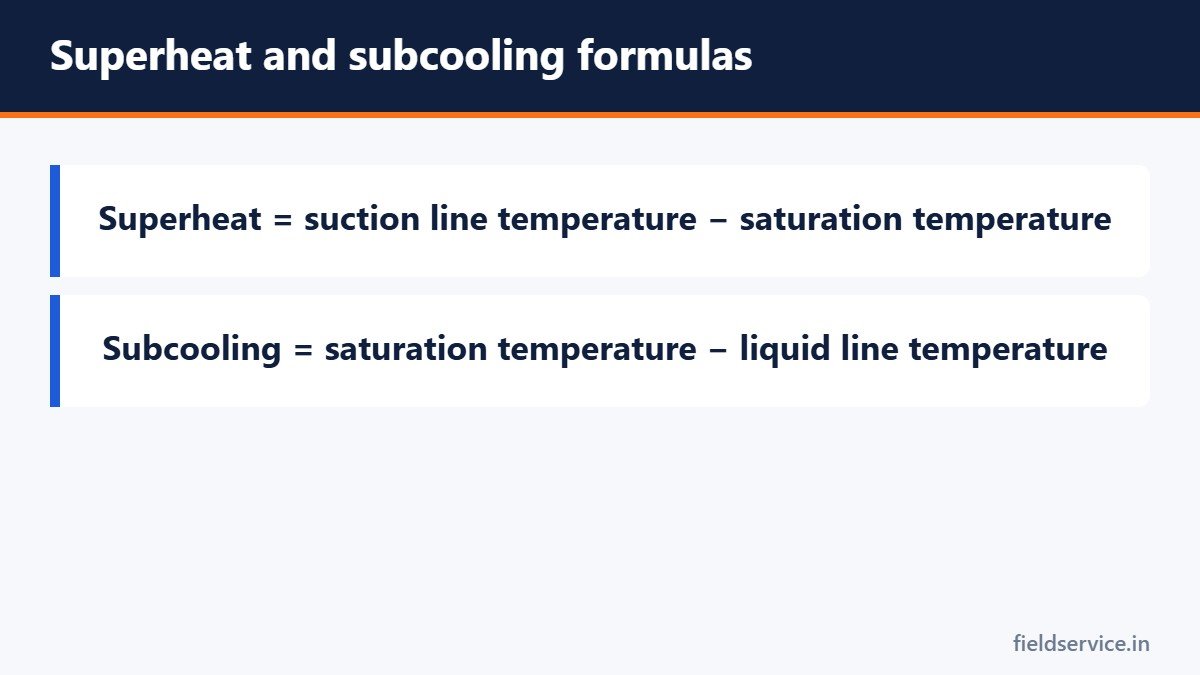
Superheat is the number of degrees a vapor has been heated above its saturation temperature. In the evaporator, liquid refrigerant boils into vapor as it absorbs heat. Once the last of the liquid has boiled, the vapor keeps picking up heat, and that extra heat is superheat.
How to measure it: read the suction pressure and convert it to saturation temperature. Measure the actual temperature of the suction line near the service port with a clamp thermometer. Subtract.
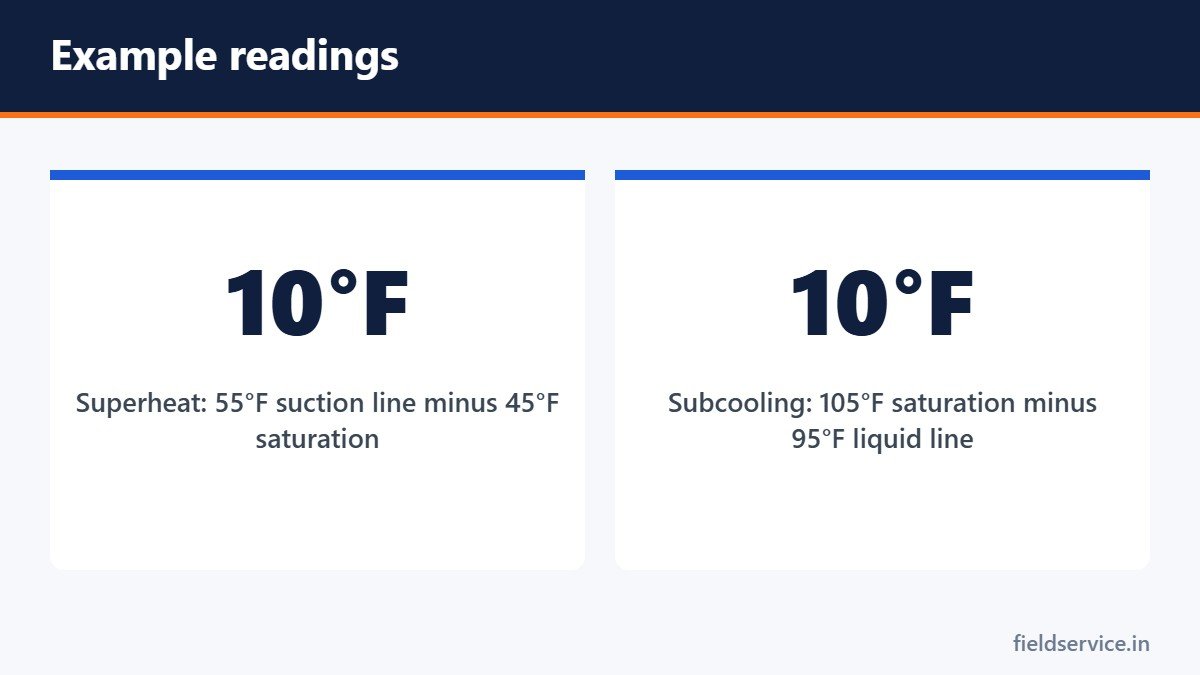
Example: the suction line measures 55°F and the saturation temperature is 45°F. Superheat is 10°F.
Superheat matters because it confirms that only vapor is returning to the compressor. Liquid refrigerant reaching the compressor can damage it.
What subcooling is
Subcooling is the number of degrees a liquid has been cooled below its saturation temperature. In the condenser, vapor gives up heat and turns to liquid. The liquid then continues to cool, and that additional cooling is subcooling.
How to measure it: read the liquid line pressure and convert it to saturation temperature. Measure the actual liquid line temperature. Subtract.
Example: the saturation temperature is 105°F and the liquid line measures 95°F. Subcooling is 10°F.
Subcooling confirms that a solid column of liquid is reaching the metering device.
Which one to charge by
- Fixed-orifice or piston systems are generally charged by superheat. The target changes with indoor and outdoor conditions, so use the manufacturer’s charging chart.
- Systems with a thermostatic expansion valve (TXV) are generally charged by subcooling, to the target printed on the unit’s data plate.
Always use the manufacturer’s target values. A rule-of-thumb number is not a substitute.
What the readings point to
| Reading | What it often indicates |
|---|---|
| High superheat | Evaporator short of refrigerant: low charge or a restriction |
| Low superheat | Evaporator flooded: overcharge or low indoor airflow |
| High subcooling | Liquid backing up in the condenser: overcharge or a restriction |
| Low subcooling | Not enough refrigerant in the condenser: low charge |
Read the two together. High superheat with low subcooling points to low charge. High superheat with high subcooling points to a restriction, such as a blocked filter drier or a metering device problem. No single reading is a diagnosis.
Getting accurate measurements
- Check airflow first. A dirty filter or coil will distort every reading that follows.
- Let the system run for 10 to 15 minutes to stabilize before measuring.
- Use a clamp thermometer on clean, bare pipe, and insulate it from the surrounding air where you can.
- Select the correct refrigerant on your gauges or PT chart.
- For blended refrigerants that have temperature glide, such as R-454B, use the dew point value for superheat and the bubble point value for subcooling.
Common mistakes
- Adding refrigerant because of low suction pressure alone
- Measuring before the system has settled
- Ignoring airflow problems
- Using a PT chart for the wrong refrigerant
You need EPA Section 608 certification to connect gauges and handle refrigerant. See EPA 608 certification explained. This article is an educational overview. Follow the equipment manufacturer’s charging instructions.
Related guides
- HVAC Unit Conversions Every Technician Should Know
- HVAC vs. Electrician vs. Plumber: Comparing the Three Big Service Trades
- GFCI vs. AFCI: What Is the Difference?
Six everyday forms in Word and PDF, plus Excel workbooks that total mileage reimbursement and overtime pay.
Not sure yet? Try two forms free or see all packs.