


Service companies hire technicians for more than technical skill. They are sending someone alone into a customer’s home or business, in a company vehicle, to represent them. The interview is where they decide whether they trust you with that. Knowing what they are looking for makes preparation much simpler.
What employers want to know
- Can you diagnose and repair the equipment they service?
- Will you show up on time and look after the truck?
- Can you talk to customers clearly and politely?
- Will you work safely?
- Are you honest about what you do not know?
Before the day
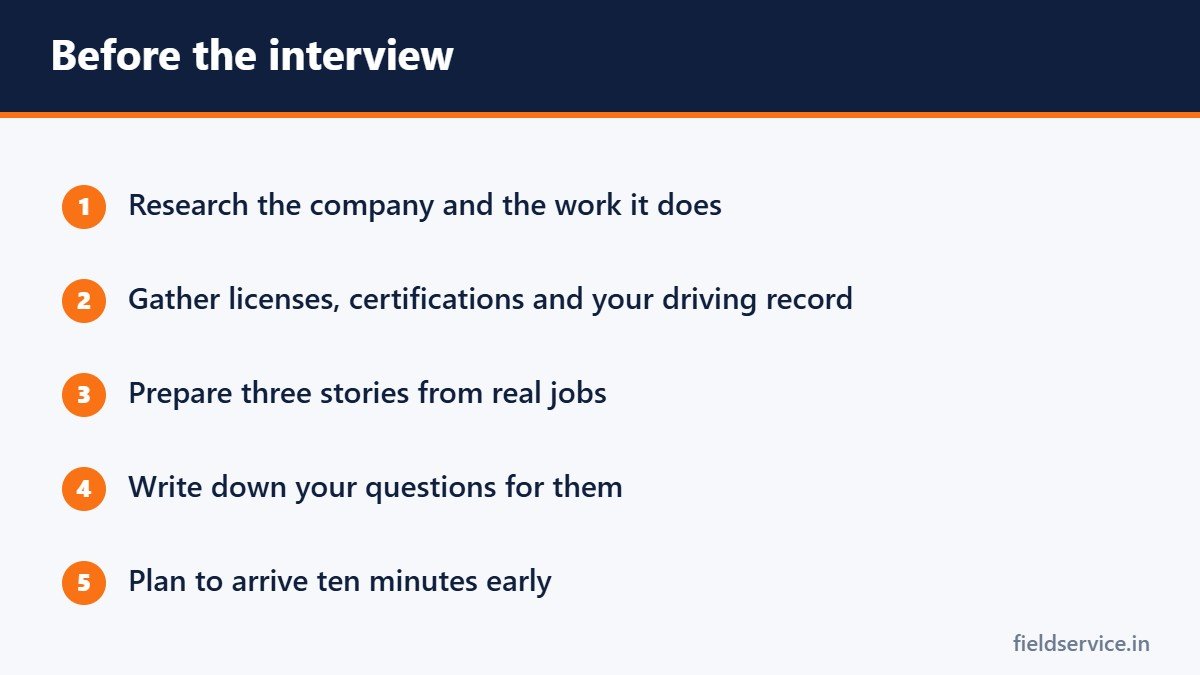
Look at the company’s website and reviews. Find out whether the work is residential or commercial, which brands they install, and whether they run service, installation or both. Bring copies of your certifications and licenses, a list of your tools, and be ready to discuss your driving record, since most service jobs involve a company vehicle.
Common questions and how to approach them
“Walk me through how you would diagnose…”
Expect a technical scenario, such as a unit that will not start. Interviewers care about your method more than a quick answer. Describe a sequence: confirm the complaint, check the basics such as power and settings, then test in a logical order and say what each result would tell you.
“Tell me about a difficult customer.”
Pick a real example. Explain what the customer was upset about, what you did and how it ended. Do not run the customer down.
“Tell me about a mistake you made.”
Everyone has one. Choose a mistake you caught and fixed, and say what you changed afterward. Refusing to name one is a worse answer than any mistake.
“How do you handle a job you cannot figure out?”
A good answer includes checking the manual, calling a senior tech or technical support, and being honest with the customer about the next step.
“How do you feel about on-call and overtime?”
Be truthful. If your availability has limits, say so now.
The hands-on test
Some employers add a practical test, such as reading a wiring diagram, using a meter or identifying components. Talk through what you are doing. If you do not know something, say so and explain how you would find out.
Questions to ask them
- How is pay structured: hourly, commission, bonuses or a mix?
- How does the on-call rotation work, and how is it paid?
- Is a vehicle provided, and can it be taken home?
- Which tools does the company supply?
- What training do you offer, and do you pay for certifications?
- How many calls does a technician run on a typical day?
Their answers tell you as much about the job as the pay rate does.

Understand the offer
Compare offers on total pay, not only the hourly rate. Look at overtime, on-call pay, benefits and whether drive time is paid. The hourly to annual pay calculator and the overtime pay calculator help you put numbers on it, and our article on how overtime pay works explains the rules.
On the day
- Arrive early and dress neatly. Clean work clothes are fine for most service companies.
- Put your phone away.
- Send a short thank-you message afterward.
Employers remember candidates who were prepared, straightforward and curious about the work. Those are the same qualities that make a good technician.
Related guides
- How to Write a Field Technician Resume
- How to Ask for a Raise as a Field Technician
- EPA 608 Certification Explained: Types, Exam and What It Allows
Six everyday forms in Word and PDF, plus Excel workbooks that total mileage reimbursement and overtime pay.
Not sure yet? Try two forms free or see all packs.