

For two years, HVAC contractors planned around a hard date. Residential and light commercial air conditioners and heat pumps using R-410A had to be installed before January 1, 2026, or the equipment could not legally go in. In May 2026 the EPA removed that deadline. The change matters for anyone holding older inventory, but it does not bring R-410A equipment back. This guide separates what changed from what stayed the same.
The background in brief
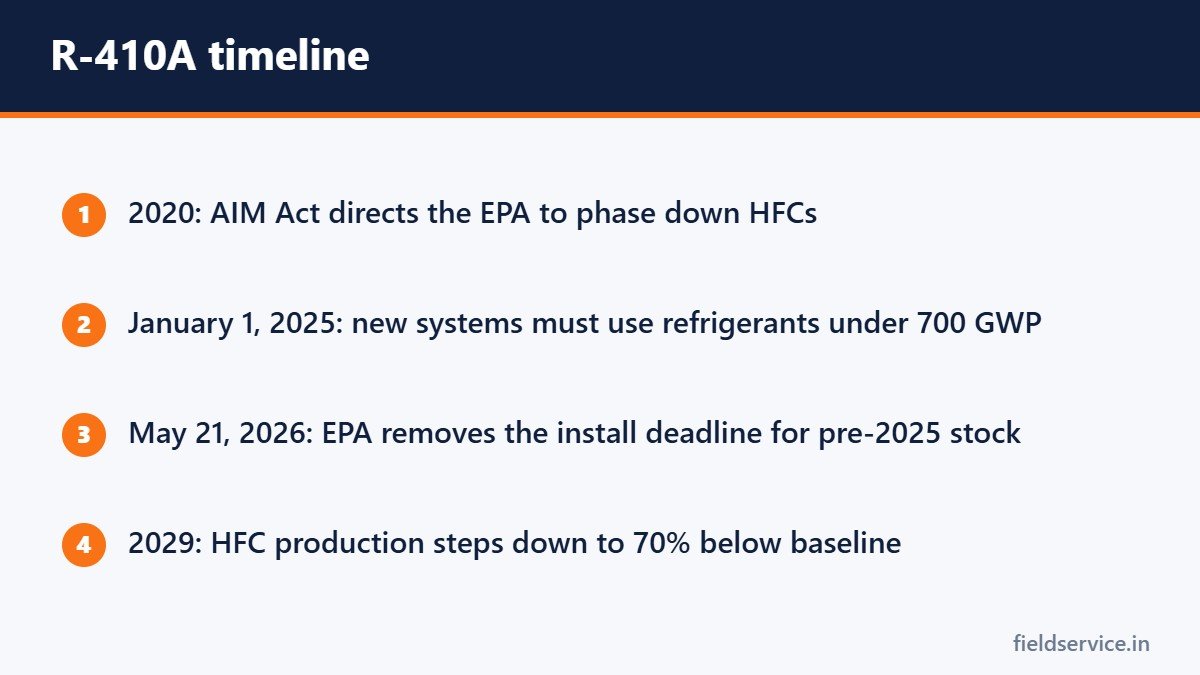
The American Innovation and Manufacturing (AIM) Act of 2020 directed the EPA to phase down hydrofluorocarbons (HFCs), a group of refrigerants with high global warming potential (GWP). The EPA acts on that in two ways:
- A production phasedown. The total amount of HFCs that can be made or imported steps down over time. It is currently 40 percent below the baseline and is scheduled to drop to 70 percent below in 2029.
- The Technology Transitions rule. Issued in 2023, it limits the GWP of refrigerants allowed in new equipment, sector by sector.
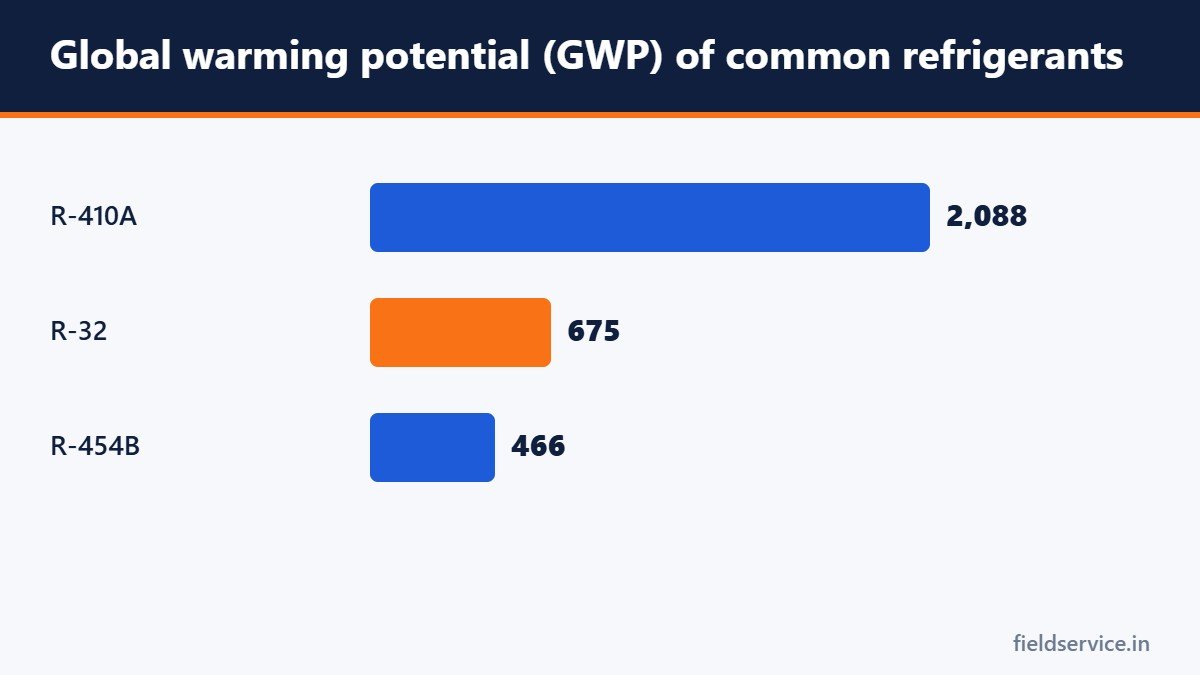
For residential and light commercial air conditioning and heat pumps, the limit is a GWP of 700. R-410A has a GWP of 2,088, so new systems could no longer be manufactured or imported with it from January 1, 2025. Manufacturers moved to R-454B, with a GWP of 466, and R-32, with a GWP of 675.
What changed in May 2026
The original rule also set an installation deadline. Split systems built before 2025 had to be installed by January 1, 2026. On May 21, 2026, the EPA finalized revisions to the rule that removed this deadline for residential and light commercial air conditioning and heat pump systems. Equipment manufactured or imported before January 1, 2025 can now be installed until the existing stock runs out.
The same action gave some commercial refrigeration sectors, including supermarkets, more time and higher temporary GWP limits.
What did not change
- New R-410A equipment is still not being made. The manufacture and import restriction that began on January 1, 2025 remains in place. The relief applies only to inventory that already exists.
- Servicing existing systems is still allowed. The rule covers new equipment. You can keep repairing and recharging R-410A systems that are already installed.
- The production phasedown continues. Less R-410A will be produced over time, which is likely to affect its price and availability for service work.
- Refrigerant handling rules still apply. You need EPA Section 608 certification to handle these refrigerants, and venting is prohibited.
What this means on the job
For most technicians the practical picture is a long overlap. There are millions of R-410A systems in service and they will need repair for many years. At the same time, nearly all new installations use R-454B or R-32. You need to be competent with both.
If your company still holds pre-2025 R-410A equipment, it can be installed. Before selling it, think about what the customer is buying: a system whose refrigerant is being phased down, which may make repairs more expensive later in its life.
Working with A2L refrigerants
R-454B and R-32 are classified A2L under the ASHRAE safety system. The A means lower toxicity. The 2L means lower flammability, a class for refrigerants that are difficult to ignite and burn slowly. R-410A is classified A1, which means no flame propagation. That difference changes some working practices:
- They are not drop-in replacements. Never charge an R-410A system with an A2L refrigerant. The equipment was not designed or listed for it.
- Check your tools. Recovery machines, vacuum pumps and leak detectors should be rated by their manufacturer for use with A2L refrigerants.
- Know the cylinders. A2L cylinders are marked with a red band and use left-hand threaded connections so that they cannot be confused with A1 cylinders.
- Control ignition sources and ventilate. Keep open flames and sparks away while the system is open, and make sure the space is ventilated.
- Follow the installation instructions. A2L systems have requirements on refrigerant charge limits for the room size, and many include a leak detection sensor that must be installed and connected correctly.
- Check local codes. Building and mechanical codes have been updated for A2L equipment, and adoption varies by state and city.
Always follow the equipment manufacturer’s instructions and the code that applies where you work. This article is a general overview and does not replace either.
Training
Your Section 608 certification covers A2L refrigerants, and there is no separate federal A2L license. Even so, manufacturers, distributors and trade associations offer A2L safety training, and it is worth taking. If you are new to the trade, our guide on how to become an HVAC technician explains how certification works.
Related guides
- HVAC Unit Conversions Every Technician Should Know
- Seasonal Planning for HVAC and Service Businesses
- Ohm’s Law for Technicians: The Formulas You Will Use Every Day
Sources
- EPA, Technology Transitions under the AIM Act
- ACHR News, EPA Removes R-410A Installation Deadline
- EPA, Section 608 of the Clean Air Act: Stationary Refrigeration and Air Conditioning
Six everyday forms in Word and PDF, plus Excel workbooks that total mileage reimbursement and overtime pay.
Not sure yet? Try two forms free or see all packs.