


There are two main ways to charge for service work. With time and materials, the customer pays for the hours worked and the parts used. With flat rate, the customer is given one price for the repair before work starts. Contractors argue about which is better, and the honest answer is that each fits certain kinds of work.
How time and materials works
You set an hourly labor rate and a parts markup. The invoice shows hours multiplied by the rate, plus parts. A two-hour repair at $120 an hour with $80 of parts comes to $320.
- Strengths: simple to set up, easy to explain, and fair on jobs where nobody can know the scope in advance.
- Weaknesses: the customer does not know the final price until the end, a slow technician costs the customer more than a fast one, and customers tend to watch the clock.
How flat rate works
You build a price book in which each common task has a fixed price. That price already includes the expected labor time, the part, travel and overhead. The technician diagnoses the fault, looks up the repair and gives the customer the price before starting.
- Strengths: the customer approves a known price, an efficient technician is rewarded, and prices are consistent from one tech to the next.
- Weaknesses: the price book takes real effort to build and keep current, and a job that runs long comes out of your margin.
| Question | Time and materials | Flat rate |
|---|---|---|
| When does the customer know the price? | After the work | Before the work |
| Who carries the risk if the job runs long? | The customer | The business |
| Who benefits if the tech is fast? | The customer | The business |
| Setup effort | Low | High |
| Best suited to | Unpredictable or large jobs | Common, repeatable repairs |
The risk question
The key difference is who carries the risk of the job taking longer than expected. Under time and materials the customer does. Under flat rate you do. That is why a flat-rate price has to be built on the average time a task takes across many jobs, not the time it takes on a good day.
Where each one fits
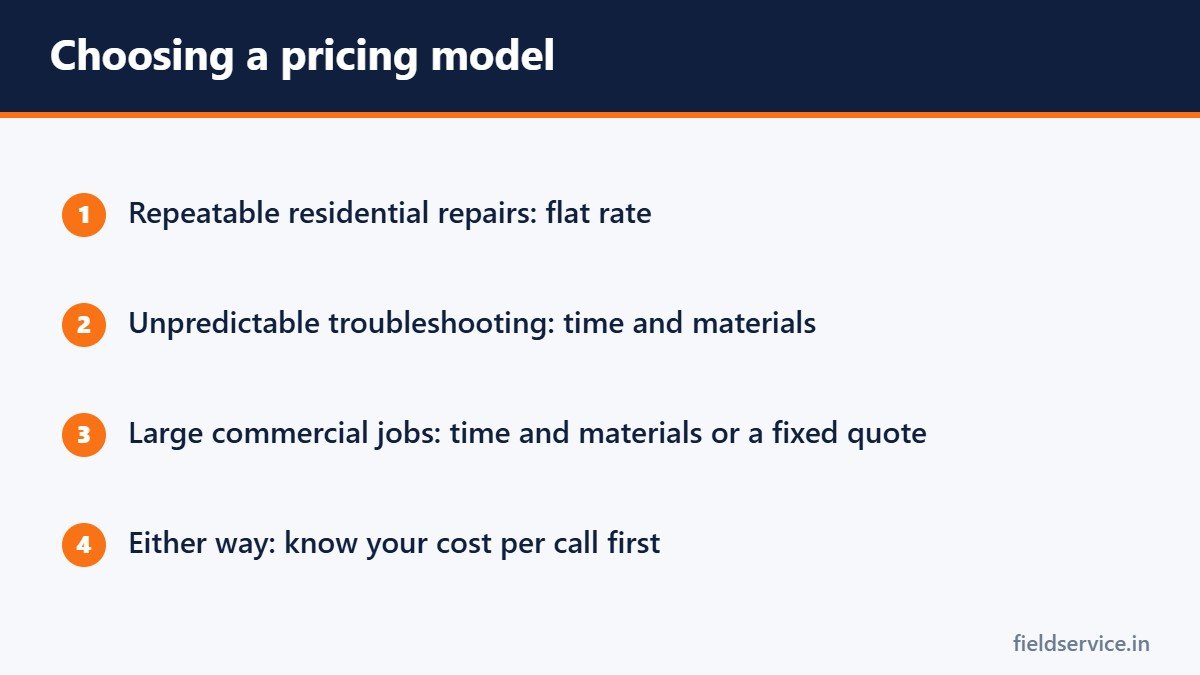
Residential service leans toward flat rate. Homeowners want to know the price before agreeing, and most repairs are common enough to price in advance. Commercial and industrial work leans toward time and materials, or toward negotiated rates, because jobs are less predictable and customers often have their own purchasing rules.
Many businesses use both: flat rate for standard repairs and time and materials for diagnosis-heavy or unusual work.
Building flat-rate prices
- Work out the cost of an hour of billable labor, including unbilled time and overhead. See hourly pay vs. billable rate.
- For each task, estimate the average time from past jobs.
- Add the part at your selling price.
- Add your profit using margin, not markup. Our markup vs. margin article explains the difference.
- Review the book at least once a year and whenever part prices move.
Whichever you choose
Neither model fixes a rate that is too low. Start by finding your cost per call with the service call minimum price calculator, then check real jobs with the job gross margin calculator. If margins are thin under one model, they will be thin under the other.
Be clear with customers about how you charge before any work begins. Most pricing complaints come from surprise, not from the amount.
Related guides
- How to Set Your Labor Rate as a One-Truck Service Business
- First-Time Fix Rate: What It Is and How to Improve It
- Loaded Labor Cost: What a Technician Really Costs Per Hour
Three Excel workbooks that take you from what a technician costs to what to charge, then show whether each job made money.
Not sure yet? Try two forms free or see all packs.