


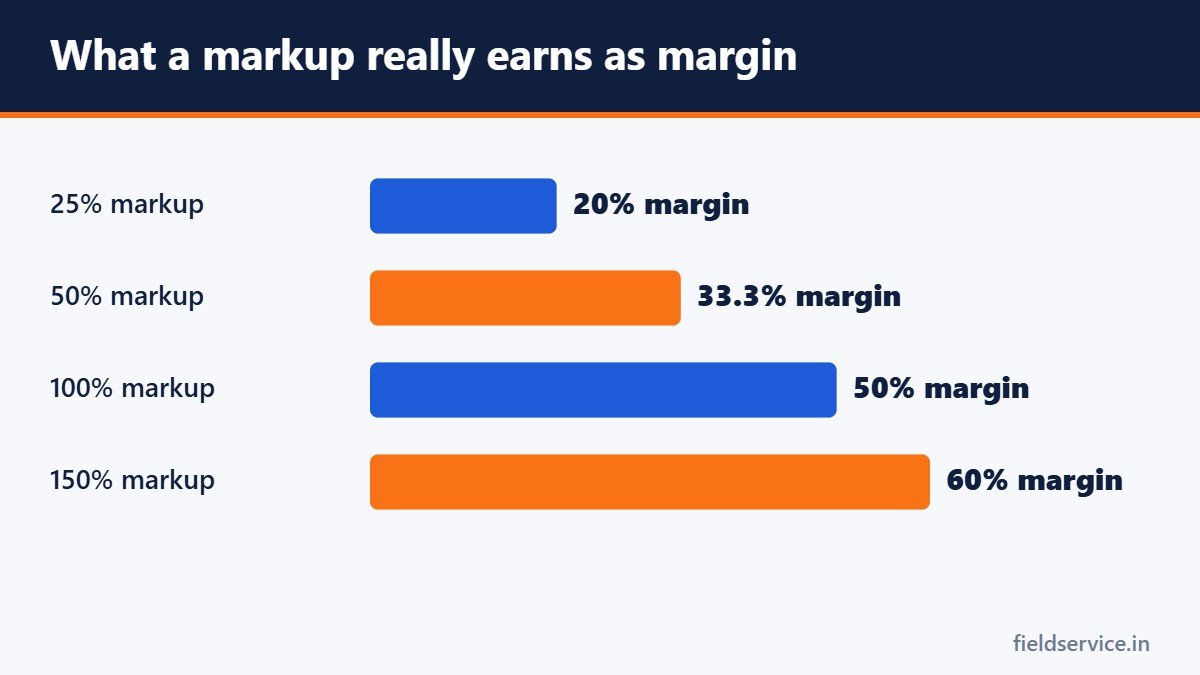
A contractor buys a capacitor for $100, adds 50 percent and sells it for $150. Ask what the shop makes on parts and the answer is usually “fifty percent.” It is not. The shop made $50 on a $150 sale, which is 33.3 percent. That gap between what an owner believes the business earns and what it really earns is the difference between markup and margin, and it is one of the most common pricing errors in service work.
The two definitions
Both numbers describe the same profit. They divide it by different things.
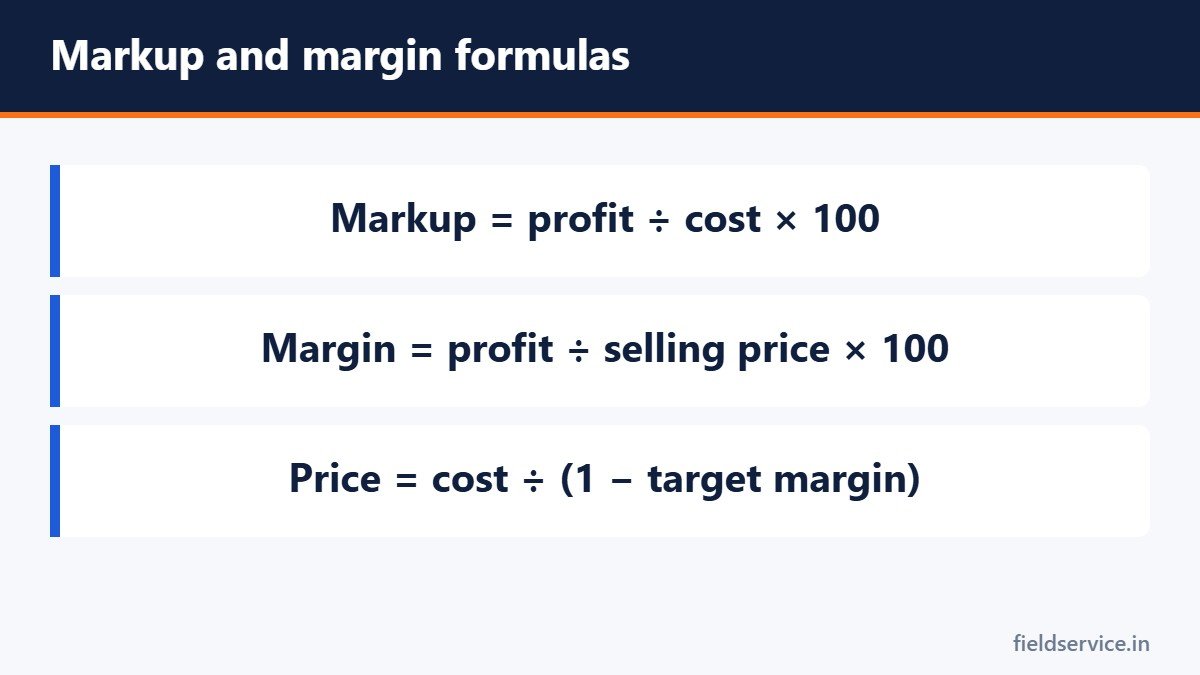
- Markup is profit as a percentage of your cost. Profit ÷ cost × 100.
- Margin is profit as a percentage of the selling price. Profit ÷ price × 100.
Because the selling price is always larger than the cost, margin is always the smaller number. A markup can be 100 percent, 200 percent or more. A margin can never reach 100 percent, because that would mean the item cost you nothing.
Why the confusion is expensive
Your overhead and your profit target are almost always expressed as a share of revenue. When your accountant says overhead runs at 35 percent of sales and you want 10 percent net profit, you need a gross margin of 45 percent. If you then go and apply a 45 percent markup, you have priced the work at a 31 percent margin. Every job comes in 14 points short and the shop loses money while staying busy.
Nothing looks wrong on any single invoice. The shortfall only shows up at the end of the quarter, when the work was steady and the bank balance did not move.
Converting one into the other
You only need two formulas:
- Margin = markup ÷ (100 + markup) × 100
- Markup = margin ÷ (100 − margin) × 100
These are the conversions that come up most often:
| Markup | Margin it produces |
|---|---|
| 25% | 20% |
| 33.3% | 25% |
| 50% | 33.3% |
| 66.7% | 40% |
| 100% | 50% |
| 150% | 60% |
So if you want a 50 percent margin on a part, you have to double its cost. If you want 40 percent, multiply cost by 1.667. The markup vs margin calculator does the conversion for any figure.
A faster way to price from a target margin
Instead of converting to markup, divide the cost by one minus the margin:
Price = cost ÷ (1 − margin)
For a $100 part at a 40 percent target margin, that is $100 ÷ 0.60 = $166.67. Check it: the profit is $66.67, and $66.67 ÷ $166.67 is 40 percent. This is the method to teach anyone who builds quotes, because it starts from the number the business actually needs.
Where service shops get caught
Parts
A flat markup applied to every part is easy to explain but treats a $4 fitting the same as a $900 compressor. Many shops use a sliding scale instead, with a high multiple on low-cost items and a lower one on expensive items. Whatever scale you use, write it down as margins as well as markups so you can compare it with your overhead. The parts markup calculator shows both.
Labor
Labor has the same problem in a different form. If a technician costs you $45 an hour fully loaded and you bill $90, the markup is 100 percent and the margin is 50 percent. But that is only true for the hours you bill. Drive time, callbacks and gaps between jobs are paid hours with no revenue, so the real margin on labor across a week is lower.
Discounts
A discount comes off the price, so it comes straight out of margin. A 10 percent discount on a job priced at a 40 percent margin leaves a 33.3 percent margin. You gave away a tenth of the price and a quarter of the profit.
What to do this week
- Pull five recent invoices and work out the real gross margin on each with the job gross margin calculator.
- Compare the result with the margin you need to cover overhead and profit.
- If your price book is built on markups, add a margin column next to it.
- Make sure everyone who quotes work uses the same word for the same number.
Markup tells you how you built the price. Margin tells you whether the price is enough. A service business needs to know the second one.
Related guides
- Flat Rate vs. Time and Materials: Which Pricing Model Fits Your Service Business?
- GPS Fleet Tracking for Service Businesses: Benefits, Costs and Privacy
- How Overtime Pay Works for Field Technicians
Three Excel workbooks that take you from what a technician costs to what to charge, then show whether each job made money.
Not sure yet? Try two forms free or see all packs.