


People often picture a trade career as doing the same job for forty years. In practice, field service offers more routes than most office careers, and many of them do not need a degree. If you are starting out, or five years in and wondering what comes next, it helps to see the options laid out.
The usual starting points
Most people begin as a helper, an installer or an apprentice, working beside an experienced technician. The work is basic and physical, and it is where you learn how equipment goes together. Within a year or two, many move on to running their own service calls. If HVAC is your trade, our guide on how to become an HVAC technician covers training and certification.
Staying on the tools
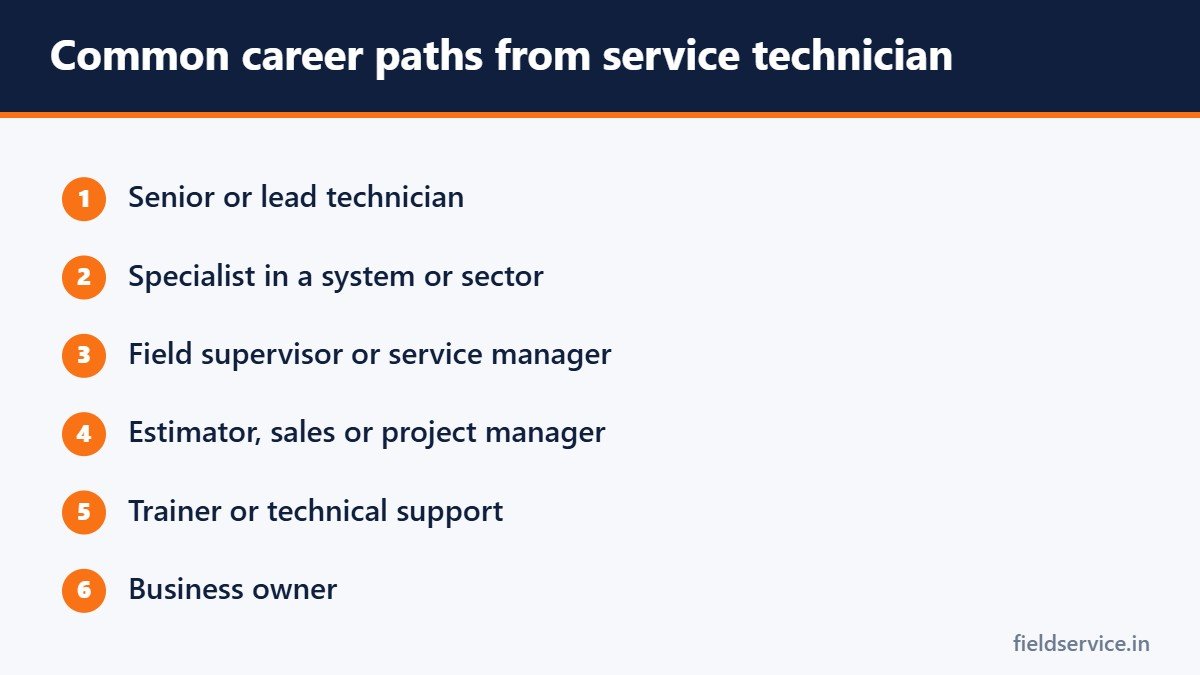
Senior or lead technician
Lead techs take the hardest diagnostic calls, back up newer staff by phone and often have first choice of work. Pay rises with experience, certifications and the ability to solve problems others cannot.
Specialist
Every trade has specialties that pay more because fewer people can do them. Examples include commercial refrigeration, building controls, boilers, medical gas, backflow testing, generators, fire alarm systems and industrial equipment. Specializing usually means extra training and sometimes additional licenses.
Moving into leadership
Field supervisor or service manager
Supervisors look after a team of technicians. They handle quality checks, training, difficult customers and scheduling problems. The move suits people who like developing others. Be aware that it swaps technical problems for people problems, and not everyone enjoys the change.
Dispatcher or operations
Technicians who move into dispatch bring something valuable: they know how long jobs really take and which tech suits which call.
Moving toward the business side
Estimator or comfort advisor
Estimators visit customers, design the solution and price the job. Good ones combine technical knowledge with clear communication, and pay is often tied to sales.
Project manager
On larger installations and commercial work, project managers plan labor, materials and schedules and keep the job on budget.
Teaching and support
Experienced technicians become trainers for contractors, trade schools, distributors and manufacturers. Others move into technical support, answering calls from technicians in the field, or become inspectors.
Starting your own business
Many technicians eventually go out on their own. The technical side is rarely what causes trouble. Pricing, cash flow, licensing, insurance and finding customers are the hard parts. Before you set your rates, read hourly pay vs. billable rate and how to price a service call.
Skills that open doors
- Strong diagnostics, especially electrical
- Clear communication with customers
- Reliable documentation
- A clean driving record and a professional manner
- Willingness to keep learning as equipment changes
How to move forward
- Tell your manager where you want to go. Most will not guess.
- Ask for the training or the type of call that builds toward it.
- Collect certifications and licenses as you become eligible.
- Keep a record of your results, such as callbacks, reviews and jobs completed.
- Find someone who has made the move you want and ask how they did it.
A trade gives you a skill that stays useful, and several directions to take it in. To see what a pay rate adds up to across a year, use the hourly to annual pay calculator.
Related guides
- Trade School vs. Apprenticeship: Which Route Into the Trades Is Right for You?
- HVAC vs. Electrician vs. Plumber: Comparing the Three Big Service Trades
- How to Prepare for a Field Technician Interview
Six everyday forms in Word and PDF, plus Excel workbooks that total mileage reimbursement and overtime pay.
Not sure yet? Try two forms free or see all packs.